Solidarity and Community: How Unity Is Built Before and After a Flood
A community does not discover its solidarity on the night the river breaks its banks. It shows the solidarity it already had, plus whatever the fire brigade, the insurer and the neighbouring country were organised to bring.

Solidarity in a community is the habit of acting for one another when it costs something. Unity is the feeling that makes the habit possible: the sense that the people on the next street, or in the next valley, are part of the same story. The two are easy to confuse because they appear together at good moments, a village fête, a local team’s promotion. They come apart under strain. A flood is one of the few events that tests both at once, in public, over months.
Communities create solidarity in three ways, roughly in this order. They build it slowly through shared institutions long before anything goes wrong. They show it suddenly in the first days of a disaster, when neighbours and strangers turn up with shovels. And they either keep it or lose it in the long, dull years of reconstruction, when the cameras have gone and the claims forms remain. Each stage has its own failures.
Solidarity and unity before the water rises
The most important acts of community solidarity happen in peacetime and look like nothing much. Someone joins the volunteer fire brigade. A parish keeps a list of elderly residents who live alone. A town council pays for river gauges and decides who rings whom when they rise.
Germany is a good example of how far this can go. The European Commission’s profile of the German civil-protection system describes more than 1.8 million volunteers as “the backbone of the system”, working through fire services, local disaster authorities, relief organisations and the federal technical relief agency THW. Maintaining an efficient fire service is a compulsory task of German municipalities. In other words, a large part of the country’s disaster response is organised neighbourliness with a uniform.
Preparation also has a financial side, and it is where unity is often weakest. In July 2021 most households in the worst-hit German regions had no natural-hazard insurance. According to the insurers’ association GDV, take-up of that cover rose from 47% to 65% in North Rhine-Westphalia and from 37% to 59% in Rhineland-Palatinate by the end of 2025. Those figures describe a community learning, after the fact, that individual insurance is also a way of not becoming a burden on everyone else. The German and Austrian arrangements explain why the cover was voluntary in the first place.
Warnings are the other test. A report by the German Committee for Disaster Risk Reduction (DKKV), summarised by the EU’s civil-protection knowledge network in July 2024, found that over 30% of respondents said they had not been warned about the rising flood risk. A warning that reaches the town hall and stops there is a failure of community as much as of technology.
The first days: neighbours, strangers and mud
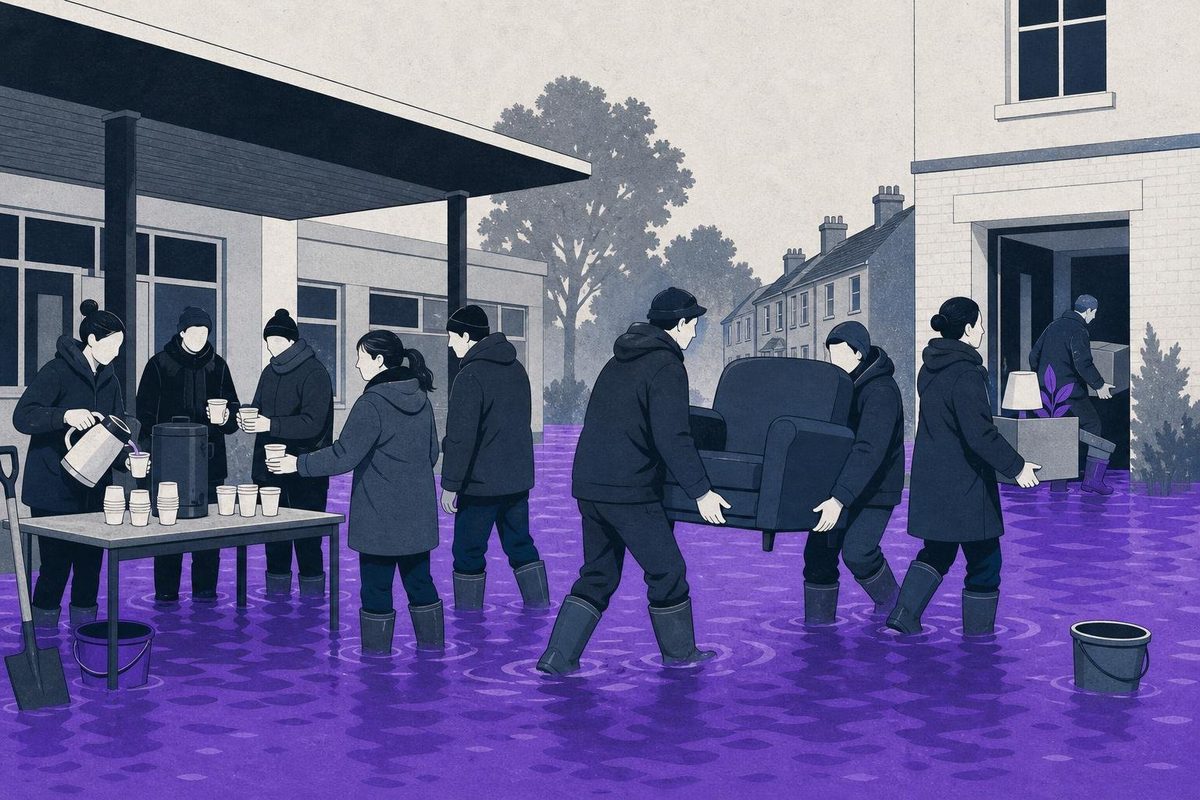
When a flood strikes, solidarity becomes visible. People arrive with buckets, pumps, sandwiches and trailers. Bakeries hand out bread. Farmers bring tractors. Much of this is unorganised, and it is often the part survivors remember for the rest of their lives.
Two recent European floods show what that looks like and where it runs into limits.
The Ahr valley, July 2021
The floods of 12–15 July 2021 killed 196 people in Germany and 42 in Belgium, according to the European Commission’s proposal for EU Solidarity Fund aid. The Ahr valley in Rhineland-Palatinate lost bridges, roads, houses and whole streets of its wine villages. Munich Re put the overall loss across Europe at €46bn, of which €11bn was insured. The Ahr valley case study sets out the figures in detail.
In the days after the flood, volunteers travelled to the valley from across Germany to clear mud and gut ruined houses, alongside the professional services and the THW. Many roads and nearly all bridges in the valley were severely damaged, according to a European Commission environment news item of January 2023, so getting people and machines to the right street was a task in itself.
Across the border, Belgium did something communities rarely do on their own: it asked its neighbours for help. On 14 July 2021 Belgium requested assistance through the EU Civil Protection Mechanism. The European Commission announced that day that a flood rescue team and a helicopter had been mobilised from France to help around Liège, that Italy and Austria had offered flood rescue teams, and that the Commission would finance up to 75% of the transport costs. Commissioner Janez Lenarčič said: “The EU stands in full solidarity with Belgium at this difficult time and is providing concrete support.”
That kind of cross-border help is community solidarity scaled up. The Belgian experience also showed how hard it is to organise. A crisis manager at the Walloon Public Service told the Commission’s civil-protection department in July 2026 that “it took almost 3 days to get an overview of the situation on the ground”, and that the crisis-management system had to be rethought. One answer was Marhetak, a Maas-Rhein taskforce funded through Interreg that joins emergency planners in Belgium, the Netherlands and Germany, because, as the same piece puts it, rivers and floods have no administrative boundaries.
Valencia, October 2024
The DANA storm that struck the province of Valencia from 28 October 2024 killed 232 people, according to the European Parliament’s legislative summary of the EU aid proposal. Paiporta, just south of the city, was among the worst-hit towns. The Valencia 2024 case study covers the losses and the insurance response.
The volunteer response was immediate and enormous. Writing for the PROCULTHER-NET 2 project in January 2025, the director of the Institut Valencià de Conservació, Restauració i Investigació described how “during the first few days the population flocked on foot to help people clean their houses.” In Picanya, where the water stood 3.80 metres high inside the parish church, volunteers worked with residents to clean the building and carry out its images and books.
Official help followed the volunteers. Spain activated the EU Civil Protection Mechanism, and the Commission’s civil-protection department reported on 20 November 2024 that a French team of 50 responders with 29 specialised vehicles and a Portuguese team of 102 personnel with 30 vehicles had joined local services to clear debris, pump water and mud and haul rubble. More than 60 Copernicus satellite maps had been produced for flood delineation and damage assessment by that date.
Valencia’s experience is a reminder that spontaneous solidarity is not a substitute for organised capacity. It filled a gap in the first days. It could not pump out underground car parks, certify buildings as safe, or pay for a new car.
What insurance does for a community
Insurance is not usually counted as community spirit, but in Spain it works as one. Every home policy carries a small compulsory surcharge for the Consorcio de Compensación de Seguros, which pays for floods and other extraordinary events no matter where in Spain they happen. After the DANA, 95.4% of claims came from Valencia province, according to the Spanish government’s note of 26 November 2025. The money to pay them had been collected from policyholders all over the country.
Valencians appear to have drawn their own conclusion. Home insurance take-up in the province rose from 78.4% to 84.5% after the floods, according to UNESPA figures reported by elDiario.es. A household that buys a policy after watching its neighbours wait for help is acting in solidarity with those neighbours as much as with itself: next time, it will not be one of the people the community has to carry. The Consorcio scheme page explains how the surcharge works.
Keeping solidarity alive during reconstruction
The hardest stage comes after the volunteers have gone home. In Germany, the Bundestag passed the “Aufbauhilfe 2021” reconstruction fund on 7 September 2021, with up to €30bn for the affected regions. The federal states pay back half of it by ceding shares of VAT revenue until 2050, which spreads the cost of one valley’s flood across the whole country for three decades. It is national solidarity on an extraordinary scale.
Five years on, though, only €6.2bn, about 20%, had been drawn by 30 June 2026, according to dpa. The gap between the promise and the spending is the main complaint of people still living in temporary arrangements. Part of it is bureaucracy, part is the sheer time it takes to rebuild bridges and sewers, and part is that some owners decided not to rebuild at all.
Belgium shows the other side. Insurers there handled about 74,000 claims and carried €2.3bn, and the Walloon Region added €1.03bn, according to Assuralia figures reported by RTBF in 2026, which says more than 98% of claims had been settled five years after the flood.
European money arrived last. The EU Solidarity Fund granted Germany €612.6m and Belgium €87.7m for the July 2021 floods, approved by the European Parliament on 14 November 2022, sixteen months after the water. Spain’s grant of €946m for Valencia was announced on 10 March 2025 as part of nearly €1.6bn in EU support. That timing is typical of the fund and is examined in the piece on EU solidarity in disasters.
Where community solidarity falls short
It is tempting to treat the outpouring of help after a flood as proof that solidarity is alive and well. The evidence is more mixed.
- It is uneven. Visible streets in well-known towns attract helpers; isolated farms and outlying hamlets wait longer.
- It is short. Volunteer numbers fall sharply after the first weeks, just as the slow work of drying, rewiring and rebuilding begins.
- It is unpriced. A community that relies on goodwill instead of insurance or public reserves is, in effect, asking the generous to pay for the unprepared.
- It stops at borders unless someone organises it not to. Cross-border help in 2021 and 2024 worked because a mechanism existed to request and coordinate it.
None of that diminishes what neighbours do for each other. It suggests that the strongest communities are the ones that turn the impulse into arrangements: a staffed fire brigade, a warning chain that reaches every door, an insurance system that pools risk across a whole country. The broader case for why those arrangements matter is made in the piece on the importance of solidarity.
Documents rescued from the flooded towns were taken to the Feria Valencia exhibition grounds to be dried and cleaned. The space set aside for them started at 6,000 square metres and had to be expanded to 10,000.
Sources
- Germany: national disaster management system, European Commission (DG ECHO) (2021-08-24)
- German Committee for Disaster Risk Reduction: Report on 2021 floods, Union Civil Protection Knowledge Network (2024-07-19)
- EU supporting Belgium with flood response (IP/21/3721), European Commission (2021-07-14)
- Proposal COM(2022) 665: mobilisation of the EUSF for 2021 disasters, European Commission / Council of the EU (2022-10-14)
- Will more frequent river floods cause widespread malfunction of European road networks?, European Commission (DG ENV) (2023-01-25)
- Natural disaster losses 2021, Munich Re (2022-01-10)
- Nearly EUR 720 million in aid for seven countries after natural disasters in 2021, European Parliament (2022-11-14)
- Ahrtalflut: Versicherer warnen vor trügerischer Sicherheit, GDV (2026-07-14)
- Hochwasser: Aufbauhilfe 2021, Deutscher Bundestag (2021-09-07)
- Erst gut ein Fünftel der Fluthilfen für Wiederaufbau genutzt, dpa via onvista (2026-07-14)
- Inondations de juillet 2021: cinq ans plus tard, plus de 98% des dossiers indemnisés, RTBF / Assuralia (2026)
- Marhetak: strengthening crisis response 5 years after the floods, European Commission (DG ECHO) (2026-07-15)
- Rescuing cultural heritage from the devastation of Valencia floods, Union Civil Protection Knowledge Network (PROCULTHER-NET 2) (2025-01-09)
- Flash floods in Spain: joining forces for rapid recovery, European Commission (DG ECHO) (2024-11-20)
- Document summary: EUSF assistance to Spain (DANA floods) and France, European Parliament Legislative Observatory (2025-10-03)
- Indemnizaciones por la DANA, La Moncloa (2025-11-26)
- Cuatro de cada diez casas no tienen seguro en una decena de provincias, elDiario.es / UNESPA
- Almost EUR 1.6 billion of EU funds will help Spain recover from Valencia's devastating floods, European Commission (DG REGIO) (2025-03-10)
Frequently asked questions
What is the difference between solidarity and unity in a community?
Unity describes a shared identity or purpose: people feel they belong to the same place and want the same things. Solidarity is what they are prepared to do about it, especially at a cost to themselves. A town can feel united at a festival and still leave an elderly neighbour alone during a flood. Solidarity is the practical test of unity, and disasters apply it.
How can a community prepare for a flood together?
The most useful steps are unglamorous. Join or support the local volunteer fire brigade or relief organisation, agree who checks on neighbours who live alone, know where the official flood warnings are published, and check whether your home insurance covers flooding. In Germany, where flood cover is voluntary, take-up rose sharply in the regions hit in 2021, which suggests many households learned this only afterwards.
Why do volunteers sometimes cause problems after a disaster?
Large numbers of spontaneous helpers can block roads that emergency vehicles need, arrive without equipment or protection against contaminated water and mud, and concentrate on visible streets while outlying houses are missed. The usual answer is to register volunteers at a meeting point and send them where they are needed, instead of turning them away. The goodwill is rarely the problem; coordination is.
Does help from other countries reach local communities quickly?
Operational help often does. Belgium asked for assistance through the EU Civil Protection Mechanism on 14 July 2021, and a French flood rescue team and helicopter were mobilised the same day, according to the European Commission. Financial help is much slower: EU Solidarity Fund grants for those floods were approved by the European Parliament in November 2022, more than a year later.
Do communities stay united after the cleaning-up is over?
Often less than they hoped. The first weeks bring an outpouring of help; the following years bring paperwork, insurance disputes and slow reconstruction. In Germany, only EUR 6.2bn of a reconstruction fund of up to EUR 30bn had been drawn by 30 June 2026, five years after the Ahr valley flood, according to dpa. Solidarity has to last as long as the rebuilding does.