Parametric Insurance Explained: How Triggers Work, With Real Examples
A parametric policy pays an agreed sum when a measured value, such as water depth or wind speed, crosses a set line. Nobody inspects the damage, which is both its great strength and its main weakness.

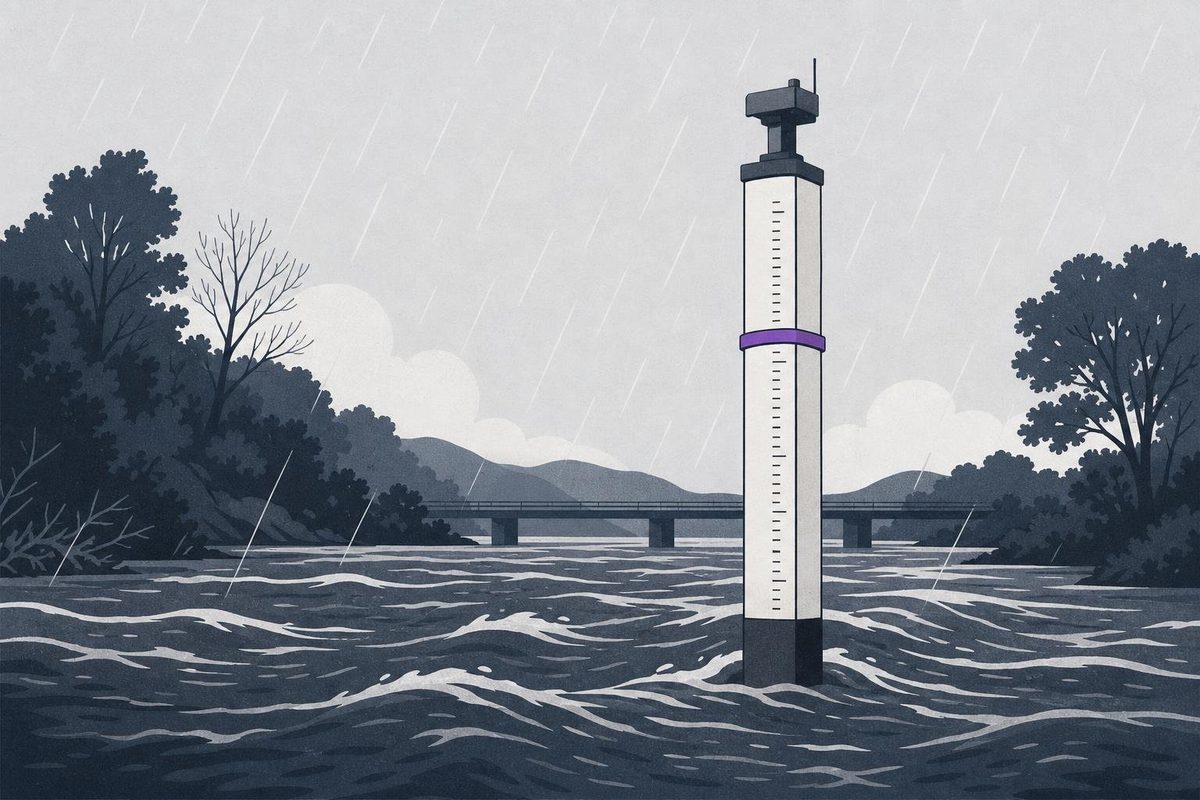
A small sensor fixed to the wall of a shop or warehouse measures how deep the water rises. If it reaches the depth chosen when the policy was bought, the policy pays an agreed amount. Nobody visits to count ruined stock or argue about the cost of new flooring. That is FloodFlash, a UK flood product for businesses offered through Marsh Commercial, and it is about as clear a picture of parametric insurance as exists in Europe.
The idea is older and much larger outside Europe. Caribbean, African and Pacific governments have used it for years to get cash quickly after hurricanes, droughts and earthquakes. In Europe it remains a niche next to the national catastrophe schemes, and the reasons say as much about the product as its successes do.
What is parametric insurance?
The question “what is parametric insurance” has a one-line answer from the BIS Financial Stability Institute and the International Association of Insurance Supervisors (IAIS). In their December 2024 paper Uncertain waters, they describe it as a contract that pays a set amount when a specific event meets a predefined intensity threshold, measured by an objective value such as earthquake magnitude, wind speed or water depth, instead of the amount of damage sustained.
Three features follow from that definition:
- The payout is fixed in advance. The policy says how much it pays at each level of the measured value. It does not promise to make good the actual loss.
- The measurement is external. A seismograph, a weather station, a satellite product or a sensor decides whether the policy pays, not a loss adjuster.
- Payment is fast. Because there is no lengthy loss adjustment, money can arrive quickly once the reading is confirmed.
Conventional property insurance works the other way round. It is called indemnity insurance because it indemnifies: it puts the policyholder back, as far as money can, in the position they were in before the loss. That requires someone to establish what was lost and what it costs to repair, which takes time and sometimes leads to disputes.
Parametric insurance against indemnity cover
| Indemnity insurance | Parametric insurance | |
|---|---|---|
| What makes it pay | Proven damage to insured property | A measured value crossing a threshold |
| How much it pays | The assessed loss, minus excess, up to the limit | A sum fixed in the contract |
| Who decides | Insurer and loss adjuster | The named data source |
| Speed | Depends on loss adjustment, slower after large events | Quick, with no loss adjustment |
| Main risk for the buyer | Disputes over cover, exclusions and valuation | Basis risk: payout and loss do not match |
| Example buyers in Europe | Households and businesses | Businesses (FloodFlash in the UK) |
Neither is better in every case. Indemnity cover fits a homeowner who needs a kitchen rebuilt. Parametric cover fits a buyer who needs liquidity quickly and can live with an imperfect match: a government that must pay emergency staff the week after a hurricane, or a café that needs to cover wages while it dries out.
How parametric triggers are built
Every parametric trigger has three parts. Get any of them wrong and the policy fails the buyer, even if it works exactly as written.
1. The index
The index is the thing being measured. It can be a physical reading at one location, such as water depth at a building or wind speed at an airport weather station. It can also be a value calculated over an area, such as rainfall across a district or the magnitude and location of an earthquake. Whatever is chosen, it must be:
- objective, so neither side can influence it;
- published reliably and quickly by a trusted source;
- closely related to the losses the buyer actually suffers.
The third condition is the hard one. A weather station in the next valley may record a gust that never reached the insured building.
2. The threshold
The threshold is the value at which the policy starts to pay. A low threshold pays often but costs more; a high threshold is cheaper but pays only in severe events. Buyers often pick a threshold that matches the point at which their own operations stop: the depth at which water reaches stock, or the wind speed at which a port closes.
3. The payout schedule
The schedule turns the reading into money. It can be binary (the full sum or nothing) or stepped, paying more as the measured value rises. Stepped schedules reduce the cliff edge of a binary contract, where a reading just below the line pays nothing at all.
Single-site and area triggers
In practice, triggers fall into two broad families, and the choice between them is the first design decision a buyer makes.
Single-site triggers measure the hazard at the insured property itself. The FloodFlash sensor is the clearest case. Because the measurement is taken where the loss happens, the match between index and damage is close, and basis risk is lower. The cost is hardware, installation and maintenance at every site, and the risk that the instrument fails, is moved or is tampered with. Single-site triggers suit businesses with one or a few fixed premises.
Area triggers use a value calculated over a wider zone: rainfall over a district, wind speed along a storm track, or the magnitude and depth of an earthquake within a set distance. They need no equipment on site and can cover a whole country in one contract, which suits cover written for governments. The price is a looser fit. A government’s losses depend on where people and roads are, not only on how strong the event was, and an area index can miss a damaging local event or overstate a remote one.
Many products sit between the two, using several stations or a grid of data cells and paying on a weighted result. That narrows the gap without closing it.
Worked example: a flood-depth parametric trigger
The following contract is hypothetical. The depths and sums are invented for illustration and do not describe any real policy.
A bakery on a high street near a river buys a sensor-based policy. The sensor is mounted inside the shop. The buyer and the insurer agree on:
- Index: maximum water depth recorded by the sensor during an event.
- Threshold: 10 cm, the depth at which water gets under the counters.
- Schedule: 25% of the agreed sum at 10 cm, 50% at 30 cm, and 100% at 60 cm or more.
In January, a river flood puts 34 cm of water through the shop. The sensor logs the reading, the insurer confirms it, and the policy pays 50% of the agreed sum. The baker does not need to submit receipts. The money can go on wages, a temporary unit or replacement ovens: the policy does not ask.
Now change the facts. Suppose the flood reaches only 8 cm at the sensor, but sewage backs up through a drain at the rear and ruins the flour store. The parametric trigger is not met and nothing is paid, even though the bakery has a real loss. Or suppose the water reaches 12 cm on a Sunday, the baker has already moved stock upstairs and the damage is trivial. The policy pays 25% anyway.
Those two outcomes are the subject of the next section.
Basis risk, explained plainly
Basis risk is the gap between what a parametric policy pays and what the buyer actually lost. It runs in both directions:
- Negative basis risk: a real loss, but the index stays below the threshold, so nothing is paid. For the buyer, this is the failure that matters most.
- Positive basis risk: the index crosses the threshold, but the loss is small or nil, so the payout exceeds the damage. The buyer gains, but the premium has to price for these payouts too.
The FSI and IAIS paper treats basis risk as the central weakness of the product. It says a mismatch between the trigger and actual losses undermines trust, can increase costs and reduces effectiveness. A farmer who loses a harvest while the nearest rain gauge records a normal season does not buy the product again, and tells the neighbours.
Basis risk can be reduced but not removed. Sensors on the insured building shrink the distance between index and loss. Stepped schedules soften the cliff edge. Combining a parametric policy with indemnity cover, so that one pays fast and the other pays properly later, is another approach. Each of these adds cost or complexity, which eats into the simplicity that made parametric cover attractive.
Parametric insurance examples from around the world
The best-known examples are regional risk pools set up for governments. They pool risk across countries that would each struggle to buy cover alone.
CCRIF (Caribbean)
CCRIF SPC, the Caribbean Catastrophe Risk Insurance Facility, was set up in 2007. It describes itself as the world’s first multi-country, multi-peril risk pool based on parametric insurance. It has 39 members, and by October 2025 it had made 82 payouts totalling about USD 483m, according to its own figures.
African Risk Capacity
The African Risk Capacity Agency was set up in November 2012 as a specialised agency of the African Union, with an insurance arm, ARC Ltd, that writes parametric cover for member states. ARC made over USD 170m of parametric payouts in its first 10 years, according to the trade publication Artemis. That total comes from trade press, not from ARC’s own published accounts.
PCRIC (Pacific)
The Pacific Catastrophe Risk Insurance Company was established in 2016. It grew out of a World Bank pilot programme launched in 2013 under the Pacific Catastrophe Risk Assessment and Financing Initiative (PCRAFI). It covers tropical cyclone, earthquake, tsunami, excess rainfall and drought for Pacific island countries.
FloodFlash (UK)
FloodFlash is the European example that comes up most often. A sensor on the insured building measures flood depth, and the policy pays an agreed amount when the chosen trigger depth is reached. It is aimed at businesses, which Flood Re does not cover. The product fills a specific hole in the UK system rather than replacing it.
What about European governments?
Europe’s national catastrophe schemes pay on assessed damage. Flood Re reimburses insurers for claims on ceded home policies. The Consorcio de Compensación de Seguros in Spain pays claims automatically, without any disaster declaration, but still on the basis of assessed loss. France’s CatNat regime is the closest to a trigger: an inter-ministerial arrêté must recognise a state of natural catastrophe for the commune before claims can be made. Even there, the arrêté only opens the door; each claim is then settled on the damage. None of the national arrangements in the UK, Spain, France, Norway, Switzerland, Germany or Austria pays on a parametric trigger; all of them settle on damage or, in Austria’s case, on discretionary aid.
Why parametric cover stays small in Europe
There are a few plain reasons why Europe has no CCRIF of its own.
The first is that the national schemes already reach most households. Switzerland insures more than 95% of buildings and contents against natural perils through its cantonal insurers and private pool. In Spain, 80.8% of homes are insured and therefore carry Consorcio cover automatically. France attaches CatNat cover to every property policy. Where indemnity cover already arrives through the ordinary home policy, a separate parametric product has little to add for a household.
The second is that European governments have other sources of post-disaster money. The EU Solidarity Fund, national disaster funds such as Austria’s Katastrophenfonds, and one-off reconstruction funds such as Germany’s after 2021 all provide public money after the event. They are slower than a parametric payout, but they exist, and they reduce the pressure on a finance ministry to buy cover in advance.
The third is that the gaps that remain are narrow and specific: businesses outside Flood Re in the UK, Italian firms before the compulsory cover took effect, uninsured homes in Romania or Greece. Those are the places where parametric examples could grow, and where the trade-offs set out below matter most.
How big is the parametric insurance market?
Nobody knows precisely. The FSI and IAIS paper quotes two commercial market-research estimates, from Global Market Insights and Allied Market Research, that put parametric premiums at USD 14.8bn to USD 18bn in 2023. That would be about 0.8% of global property and casualty premiums. The paper itself stresses that most supervisory authorities do not have market-size data of their own, so these figures are estimates from vendors, not official statistics.
Even at the top of that range, parametric cover is small next to the losses it might address. The Swiss Re Institute’s sigma No 1/2026 puts the global natural catastrophe protection gap at USD 112bn in 2025, or 51% of economic losses. Parametric cover is one tool among several for narrowing that gap, not a replacement for conventional insurance.
Where parametric cover fits next to national schemes
In Europe, parametric cover is best understood as a complement to the systems described in the national schemes section. Those schemes do the heavy lifting for households. Spain and France attach catastrophe cover to ordinary policies; the UK uses Flood Re for eligible homes; Germany relies on voluntary cover and ad-hoc state aid.
Parametric products fit where those systems leave gaps or move slowly:
- Who is excluded. Flood Re covers homes built before 2009 and leaves businesses out. A sensor-based business policy speaks directly to that gap. The guide to home insurance in flood risk areas sets out what households can and cannot get.
- How fast money arrives. Indemnity claims after a large flood can take months, and public money can take longer. After the 2024 Valencia floods, the EU Solidarity Fund paid a EUR 100m advance and then EUR 846m in 2026, more than a year after the event. In Germany, only about 20% of the up to EUR 30bn reconstruction fund for the 2021 floods had been drawn by 30 June 2026, according to dpa. A parametric payout to a public body or business could cover the first weeks.
- What the money is for. An indemnity policy pays only for the losses it names. A parametric policy does not ask what the money is spent on, so a business can use it for wages, rent or extra staff during a clean-up.
The scale of the problem is set out on the protection gap page. EIOPA’s 2025 dashboard finds that only around a quarter of Europe’s natural catastrophe losses over 1980–2024 were insured. Parametric insurance does not change that figure much by itself, because it reaches few households. Where it could matter is in public finance: a regional government with a parametric policy has money on day one, instead of waiting for an EU Solidarity Fund grant.
Limits and criticisms
The case against relying on parametric cover is not that it fails, but that it is narrow.
Basis risk does not go away. Better sensors and finer data reduce it, but every contract will sooner or later meet an event its trigger did not anticipate. A buyer who has relied on parametric cover alone then has nothing.
Data quality decides everything. Where weather stations are sparse or sensors fail, the index is only as good as the measurement behind it. That is a bigger problem in exactly the places where conventional insurance is weakest.
The price still has to be paid. A parametric premium reflects the expected payouts, including the positive basis risk. For a poor household or a small municipality, it is not obviously cheaper than indemnity cover, only different.
Supervisors are still catching up. The FSI and IAIS paper notes the lack of reliable market data, and asks in its title whether parametric insurance can help bridge natural catastrophe protection gaps. Its weight on basis risk and missing data makes clear that the answer depends on how each contract is designed.
It does not rebuild anything. An indemnity payout is linked to a repair. A parametric payout is cash, and the policy does not require it to be spent on the damage. That flexibility is useful, but it means the money can fund wages while the building stays wet. Flood Re’s Build Back Better scheme, which pays up to £10,000 for resilience measures during a repair, is an example of the opposite approach: tying money to what is rebuilt and how.
For a buyer weighing up what is parametric insurance worth to them, the honest test is the bakery example above. If the 8 cm flood with the ruined flour store would sink the business, a parametric trigger alone is the wrong product.
Sources
- FSI Insights No 62: Uncertain waters: can parametric insurance help bridge NatCat protection gaps?, BIS Financial Stability Institute and IAIS (2024-12)
- About us, CCRIF SPC (payout figure as at October 2025)
- African Risk Capacity makes over $170m of parametric payouts in first 10 years, Artemis
- Formation and History, Pacific Catastrophe Risk Insurance Company
- Parametric Flood Insurance (FloodFlash), Marsh Commercial
- Flood Re eligibility criteria, Flood Re
- The dashboard on insurance protection gap for natural catastrophes in a nutshell (EIOPA-BoS-25/564), EIOPA (2025-11-10)
- sigma No 1/2026: Natural catastrophes in 2025: the persistent rise of wildfire and storm risk, Swiss Re Institute (2026-03-19)
- Catastrophe insurance in Spain: the Consorcio de Compensación de Seguros, Consorcio de Compensación de Seguros (2016-12)
- Catastrophe naturelle : quelle indemnisation ?, Service-Public.fr (checked 2026-04-10)
- Flood Re Annual Report and Accounts 2025-26, Flood Re (2026-06-30)
- Almost EUR 1.6 billion of EU funds will help Spain recover from Valencia's devastating floods, European Commission, DG REGIO (2025-03-10)
- Erst gut ein Fünftel der Fluthilfen für Wiederaufbau genutzt, dpa via onvista (2026-07-14)
Frequently asked questions
Is parametric insurance the same as a catastrophe bond?
No, although the two can overlap. Parametric insurance is a contract between a policyholder and an insurer or risk pool that pays on a measured index. A catastrophe bond is a security sold to investors, who lose some or all of their principal if a defined disaster happens. Some bonds use parametric triggers, others use indemnity or industry-loss triggers.
Who sets the trigger in a parametric policy?
The trigger is agreed before the policy starts, between the buyer and the insurer or pool, usually with a modelling firm or data provider involved. The buyer chooses within limits: a lower threshold pays more often and costs more, a higher one is cheaper but pays only in severe events. The data source that will decide the payout is named in the contract.
Can a household in Europe buy parametric cover for its home?
The best-known UK example, FloodFlash, is sold to businesses and measures flood depth with a sensor on the building. Most European homes get catastrophe cover through ordinary home insurance, often backed by a national scheme such as Flood Re in the UK or the Consorcio in Spain.
What happens if the trigger is met but there is no damage?
The policy still pays. A parametric contract promises money when the measured value crosses the threshold, not compensation for a proven loss. This is the reverse side of basis risk: the buyer may receive a payout in an event that caused little harm, just as it may receive nothing in an event that caused a lot. Pricing reflects both possibilities.
How quickly does a parametric policy pay out?
Faster than indemnity cover, because there is no lengthy loss adjustment. Once the data provider confirms the reading, the payout follows the schedule in the contract. Exact timings vary by product and are set in each policy. Quick payment is the advantage the FSI and IAIS paper puts first in its definition of the product, ahead of any other feature.