Disaster risk case studies in Europe: who paid and what failed
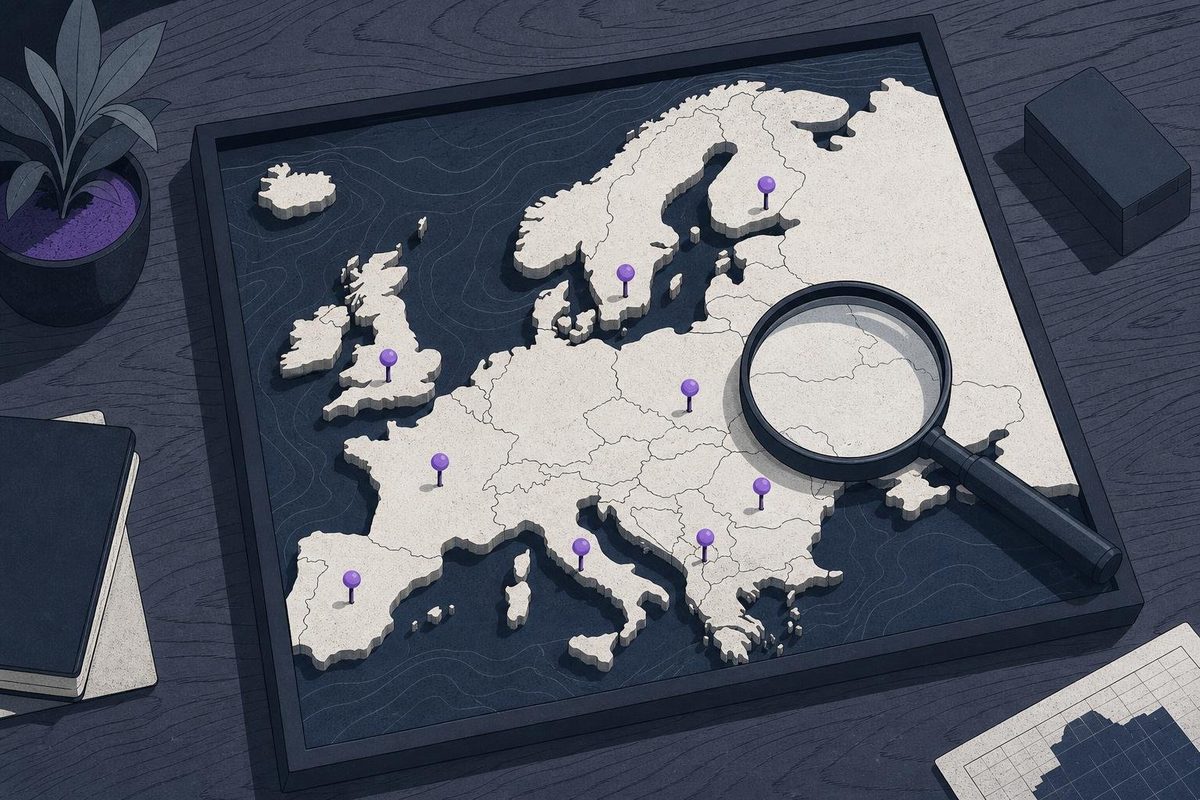
Eleven cases from Iceland to Valencia, numbered on the map: four recent disasters with their loss and payment records, and seven partnerships studied by the ENHANCE research project between 2012 and 2016.

The numbered markers on the map above are not a random sample of European disasters. Each one stands for a case where the question “who pays?” got a specific answer, sometimes a planned one and more often an improvised one.
Cases 1 to 4 are recent events with published loss records: the 2010 ash cloud from Eyjafjallajökull, the July 2021 floods in the Ahr valley, the May 2023 floods in Emilia-Romagna and the October 2024 DANA floods around Valencia. For each, the record shows how much was lost, how much was insured and which public funds filled the rest.
Cases 5 to 11 come from ENHANCE, a research project funded under the EU’s Seventh Framework Programme (grant agreement 308438, December 2012 to November 2016). According to CORDIS, the project cost EUR 7,687,123 in total, with an EU contribution of EUR 5,992,084. Its consortium of 24 partners from 11 countries built its work around ten case studies of what it called multi-sector partnerships: arrangements in which public authorities, companies and civil society share the job of managing a risk. Seven of those cases have pages here and markers on the map. The eighth, the volcanic ash case, doubles as case 1.
The two groups answer different questions. The events show where the money came from after the fact. The ENHANCE cases show people trying, with mixed success, to agree the split before the next disaster.
How to read the atlas
The numbering is fixed, and every other page on the site uses it.
| No. | Case | Hazard | Region | Type |
|---|---|---|---|---|
| 1 | Eyjafjallajökull ash cloud, 2010 | Volcanic ash | Iceland and European airspace | Event, and ENHANCE case |
| 2 | Ahr valley floods, 2021 | River and flash flood | Germany, Belgium and neighbours | Event |
| 3 | Emilia-Romagna floods, 2023 | River flood and landslides | Northern Italy | Event |
| 4 | Valencia DANA, 2024 | Flash flood | Eastern Spain | Event |
| 5 | Po basin | Flood and drought after an earthquake | Northern Italy | ENHANCE case |
| 6 | North Sea and Wadden Sea | Storm surge | Netherlands and Germany | ENHANCE case |
| 7 | EU Solidarity Fund and Romania | Flood and earthquake | Romania and the EU | ENHANCE case |
| 8 | London flood risk | Flood | United Kingdom | ENHANCE case |
| 9 | Júcar river basin | Drought | Eastern Spain | ENHANCE case |
| 10 | Chamusca | Wildfire | Portugal | ENHANCE case |
| 11 | Austrian Alpine railways | Floods, debris flows, avalanches | Austria | ENHANCE case |
Markers for the ENHANCE cases sit on a representative named place in each study region, such as Bucharest for the Romanian case or Albacete for the Júcar basin. They mark the region, not a single site.
Recent disasters and who paid (cases 1–4)
1. Eyjafjallajökull ash cloud, Iceland, 2010
The eruption under the Eyjafjallajökull ice cap from 14 April 2010 did almost no physical damage outside Iceland, and still produced one of the costliest disruptions in European aviation. EUROCONTROL counted 104,000 flights cancelled between 15 and 22 April. IATA estimated USD 1.7bn of lost airline revenue. The losses were nearly all uninsured, because they were lost revenue rather than damage, and EU passenger-rights law put the cost of caring for stranded travellers on the airlines. The Iceland volcano case study sets out the three loss figures and what each measures, and what the ENHANCE team at the University of Iceland examined.
2. Ahr valley and the July 2021 floods
The rain of 12 to 15 July 2021 hit Germany, Belgium, the Netherlands, Luxembourg and Austria. The Commission’s proposal to mobilise the EU Solidarity Fund, COM(2022) 665, records 196 deaths in Germany and 42 in Belgium. The worst damage was in the Ahr valley in Rhineland-Palatinate, where the marker sits on Bad Neuenahr-Ahrweiler.
Munich Re put the overall loss at EUR 46bn and the insured loss at EUR 11bn, a share of 23.9%; for Germany alone, EUR 33bn and EUR 8.2bn. The German federal and state governments set up the “Aufbauhilfe 2021” reconstruction fund of up to EUR 30bn, passed by the Bundestag on 7 September 2021, with the Länder repaying half by ceding VAT revenue until 2050. By 30 June 2026 only EUR 6.2bn, about a fifth, had been drawn, according to dpa. Belgian insurers handled about 74,000 claims and bore EUR 2.3bn, with the Walloon Region adding EUR 1.03bn. The EU Solidarity Fund paid EUR 612.6m to Germany and EUR 87.7m to Belgium. The Ahr valley case study follows the money in detail, including the rise in take-up of natural-hazard cover that followed.
3. Emilia-Romagna floods, May 2023
Two rounds of rain between 2 and 22 May 2023 flooded large parts of Emilia-Romagna, with damage also in Marche and Tuscany. PERILS counted 17 deaths; the Commission gives 14. PERILS estimated the economic loss at EUR 9bn and the insured property loss at EUR 495m, about 5.5%, and noted that roughly half of the losses hit public infrastructure.
Italy declared EUR 8,533m of direct damage to the EU Solidarity Fund, well above its EUR 3.8bn threshold for a major disaster, and received EUR 378.8m for Emilia-Romagna plus EUR 67.8m for Tuscany. The more lasting response was legal. Law 213/2023 made catastrophe cover compulsory for Italian businesses, with the state-owned SACE reinsuring up to half of claims, and the start date was then moved several times by decree. The Emilia-Romagna case study sets out that timeline. The marker is on Faenza, one of the worst-hit towns.
4. Valencia DANA, October 2024
Between 28 October and 4 November 2024 an isolated upper-level low (DANA in Spanish) dropped extreme rain on the province of Valencia. The European Parliament’s summary of the Solidarity Fund proposal records 232 deaths. Spain declared EUR 20.28bn of direct damage and the Commission accepted EUR 18.08bn as plausible. Munich Re’s early estimate was USD 11bn overall and USD 4.2bn insured.
This is the event where a standing national scheme carried most of the insured loss. Spain’s Consorcio de Compensación de Seguros (CCS) covers floods automatically for anyone with a property, motor or other qualifying policy. By 27 March 2026, according to SegurosNews reporting CCS figures, it had registered 251,549 claims and paid EUR 4,378,657,847 on 212,237 of them, with a final cost expected at about EUR 4.8bn. Cars, homes and shops each accounted for roughly EUR 1.1bn to EUR 1.2bn. On the public side the EU Solidarity Fund granted EUR 946,153,691, the second-largest grant in its history, and the RESTORE mechanism reallocated EUR 645m of cohesion funds, which DG REGIO says brought EU support to nearly EUR 1.6bn. The Valencia case study covers both. The marker sits on Paiporta.
The three floods side by side
| Case | Economic loss | Insured loss | Insured share | Source |
|---|---|---|---|---|
| 2. Ahr valley and neighbours, 2021 | EUR 46bn | EUR 11bn | 23.9% | Munich Re |
| 3. Emilia-Romagna, 2023 | EUR 9bn | EUR 495m | 5.5% | PERILS |
| 4. Valencia, 2024 | USD 11bn | USD 4.2bn | 38.2% | Munich Re |
Each share uses a total and an insured figure from the same source. Valencia’s 38.2% is already out of date in one direction, since CCS payments alone have passed Munich Re’s early insured estimate. It is not a ranking of national schemes either. Germany has no compulsory cover, Italy’s compulsory cover for businesses was legislated only after the 2023 floods, and Spain’s Consorcio has existed in permanent form since 1954.
The ENHANCE case studies (cases 5–11)
ENHANCE chose its cases for variety: different hazards, different places and scales from a single municipality to the whole EU, and a mix of partnership types (emergency response, risk reduction and financial). Each case was meant to test whether a new or improved partnership could reduce risk, using the project’s work on economic instruments, regulation and future risk scenarios. The project’s final book, published in late 2016, reported that ten public-private-civil society partnerships had been set up or developed, with particular attention to the financial sector.
5. Po basin: floods after an earthquake, and drought
The magnitude 5.9 earthquake of May 2012 in Emilia damaged land-drainage infrastructure and raised flood risk over about 1,000 square kilometres between the Po, Secchia and Enza rivers, with potential losses put at EUR 10bn. The emergency answer was a temporary plan to flood low-value farmland on purpose to protect towns. The Po basin case study asked how that could become a lasting arrangement with fair compensation for the farmers whose fields take the water.
The same district had faced the opposite problem in 2003, when the Po fell to a record low of 270 cubic metres a second against an average of 1,400, and the major water users formed a Drought Steering Committee in May 2003. The case was led from FEEM, with Jaroslav Mysiak as contact. Eleven years later the floods of case 3 hit the same region.
6. North Sea and Wadden Sea: storm surges and risk culture
The North Sea coast has a long record of deadly storm surges, including those of 1953 and 1962. Since 1962, after heavy investment in coastal defences, no one has died in a surge there. The Wadden Sea case study compared risk cultures in the Netherlands and Germany, looked at how the arrangements built after 1953 and 1962 still shape coastal protection, and asked whether culture-based approaches to resilience can be transferred across the border. Partners included the Trilateral Wadden Sea Secretariat, the Lower Saxony and Schleswig-Holstein coastal agencies and the Wadden Sea Forum. Birgit Gerkensmeier of Helmholtz-Zentrum Geesthacht argued in an interview on the case that the region needs multi-hazard thinking, with demographic change on the list next to the sea. The marker is on Wilhelmshaven, seat of the Trilateral Wadden Sea Secretariat.
7. Testing the EU Solidarity Fund in Romania
This was the only case aimed squarely at an EU instrument. The EU Solidarity Fund has paid out after major disasters since 2002; when ENHANCE studied it, the total was over EUR 3.7bn across 63 disasters, and DG REGIO now gives over EUR 9.6bn across 110 natural disasters. The Romania case study raised the moral-hazard problem directly: aid that arrives only after a disaster can weaken the reason to prevent one. It proposed turning the fund towards a pre-disaster, risk-based instrument, and looked at a link with Europa Re, a Swiss-based catastrophe reinsurer owned by Albania, North Macedonia and Serbia. The team, from the Bucharest University of Economic Studies and IIASA, built two scenarios for Romania, one with risk-reduction measures in place before a disaster and one with Solidarity Fund intervention under existing rules. Romania still scores 11.5 out of 20 on EIOPA’s 2025 protection-gap dashboard, with a flood score of 3.
8. London: flood risk, insurance and Flood Re
Led by Swenja Surminski of the London School of Economics, the London case study started from the expectation that the city’s flood risk will grow with urban growth, climate change and ageing defences. It examined the public-private flood insurance arrangement in the UK, including the then-proposed Flood Re, alongside the London Climate Change Partnership and the Greater London Authority’s Drain London programme on surface water. With the University of Oxford it built an agent-based model of how insurance-related instruments affect behaviour. Surminski’s verdict, given in a 2014 interview, was that the link between risk transfer and physical risk reduction is weak in practice, and that property developers matter as much as insurers.
9. Júcar river basin: drought
The Júcar basin in eastern Spain has a semi-arid climate and heavy water demand, and suffered multi-year droughts in 1985–1988, 1990–1995, 2000–2002 and 2005–2008. The Júcar case study, led from the Universitat Politècnica de València, brought in farmers’ irrigation groups, the Valencia metropolitan area, the city of Albacete, the hydropower company Iberdrola and environmental groups. It explored economic instruments not yet used in the basin, such as water pricing and trading, alongside partnerships and regulation. Drought costs rarely reach an insurer at all, which makes it the clearest case on the map of a risk shared almost entirely through water rules.
10. Chamusca: wildfire and forest insurance
In 2003 fires burnt nearly 22,000 hectares in the municipality of Chamusca in central Portugal, about 30% of its area, and killed four people, two of them firefighters. The Chamusca case study, led from the Instituto Superior de Agronomia in Lisbon, analysed the causes of the fires and the policies adopted afterwards, surveyed local practice and risk perception, and developed forest insurance models for the region. Its partners included the municipality, a landowners’ association, the pulp and paper company Altri and the local fire brigades. Portugal’s wildfire score on EIOPA’s 2025 dashboard is 3, a relevant gap.
11. Austrian Alpine railways
Floods, debris flows, rock fall and avalanches regularly damage Austrian rail lines, many of which were built in the 19th century along river valleys. The Alpine rail case study worked with ÖBB Infrastruktur, the national rail infrastructure company, on two lines in detail. It found a partnership hampered by uneven information exchange and disagreement over who should pay for protection. The team, led from the University of Potsdam with the railway consultancy OpenTrack, used multi-criteria analysis rather than cost-benefit analysis alone and developed damage functions for rail infrastructure. Andreas Schöbel of OpenTrack noted in an interview that the Ministry of Transport had no staff dedicated to Alpine rail resilience. The marker sits on Innsbruck, in Tyrol.
Two ENHANCE cases without a marker
ENHANCE ran two further cases that are not on the map. One looked at flood risk on unembanked industrial land in the Port of Rotterdam, summarised in a 2016 project note on the port partnership; the final book reported that the Port Authority, the city and the Dutch infrastructure ministry committed roughly EUR 200,000 to further climate-risk analysis of the port. The other studied heatwave plans and health care in Belgium and the Netherlands, and a 2016 study from that case found that care homes and hospitals named in national heat plans were often unaware of them.
What the cases show together
Cost sharing is mostly decided after the event
In three of the four recent disasters, the split between insurers, governments and the people affected was settled in the weeks after the damage. Germany’s Bundestag voted the reconstruction fund on 7 September 2021, less than two months after the flood. Italy wrote compulsory business cover into law after Emilia-Romagna. EU passenger-rights law and the courts settled the ash-cloud bill, with the Court of Justice ruling in 2013, three years after the eruption.
Valencia is the exception. The Consorcio’s rules, surcharge and reserve were all in place before the rain fell, so the 251,549 claims went through an existing machine. That does not make Spain’s model free: Spaniards pay the surcharge every year whether or not anything happens, and households without a policy get nothing from it. But it is the only case on the map where the answer to “who pays?” was known in advance.
Speed is the other trade-off, and it cuts against the improvised model. A fund voted in a hurry is not money spent in a hurry. Of the up to EUR 30bn set aside for Aufbauhilfe 2021, dpa reported that only EUR 6.2bn had been drawn by 30 June 2026, almost five years after the flood. Part of that gap is ordinary: rebuilding bridges, railways and schools takes years whatever the funding. Part of it is the cost of designing eligibility rules, application forms and audit trails after the event rather than before it. A standing scheme has already paid that cost. By March 2026, seventeen months after the Valencia floods, CCS had settled 212,237 of its 251,549 claims.
Partnerships work best when someone is paying
The ENHANCE partnerships that produced something concrete had money behind them. Rotterdam’s commitment of roughly EUR 200,000 came from the parties that stood to lose. The Po basin arrangement mattered because farmers’ land was being flooded to save towns, and the question of compensation could not be avoided. Where the money was missing, the partnership was weak. The Austrian rail case found disagreement over cost sharing at the heart of its problems, and the Romanian case was built on the observation that EU aid after the fact removes some of the reason to pay for prevention beforehand.
There is a fair argument the other way. The Wadden Sea case is a partnership of a different kind, built on shared culture and long investment in coastal defence, and no one has died in a surge there since 1962 without a financial instrument at its centre. Cost sharing is one route to a working partnership, not the only one.
The gaps that keep coming back
Three gaps recur across the eleven cases.
- Public infrastructure. Half the Emilia-Romagna losses fell on public assets. The Austrian railways, the Po drainage network and the Júcar water system are all public or semi-public. These assets are rarely insured, so their repair bill goes to taxpayers and EU funds.
- Losses without damage. The ash cloud, drought in the Júcar basin and the heat cases share a problem: the loss is real, but nothing is physically broken, so property insurance does not respond. Parametric triggers are one proposed answer, set out on the parametric insurance page.
- People outside the scheme. Even where a national scheme exists, it reaches only those who hold the underlying policy. In Spain that leaves the 19.2% of homes without insurance; in the UK it leaves homes built after 2008 outside Flood Re. EIOPA’s numbers for each country are on the protection gap page.
The schemes comparison puts the national arrangements behind cases 2 to 4 and 8 side by side.
One detail ties the map together more neatly than any summary. The Júcar drought case, case 9, worked with the metropolitan area of Valencia on how to share scarce water. Twelve years after the project started, the same metropolitan area flooded. Spain had been one of the countries the ENHANCE consortium cited, in its 2013 response to the Commission’s Green Paper on disaster insurance, as having mandatory elements in its insurance system, and that mandatory element is what paid.
Sources
- Natural disaster losses 2021, Munich Re (2022-01-10)
- Proposal to mobilise the EU Solidarity Fund, COM(2022) 665, European Commission (2022-10-14)
- Nearly EUR 720 million in aid for seven countries after natural disasters in 2021, European Parliament (2022-11-14)
- Ahrtalflut: Versicherer warnen vor trügerischer Sicherheit, GDV (2026-07-14)
- Aufbauhilfe 2021: Bundestag beschließt Hilfsfonds, Deutscher Bundestag (2021-09-07)
- Erst gut ein Fünftel der Fluthilfen für Wiederaufbau genutzt, dpa via onvista (2026-07-14)
- Inondations de juillet 2021: cinq ans plus tard, plus de 98% des dossiers indemnisés selon Assuralia, RTBF (2026)
- PERILS press release: Emilia-Romagna floods 2-22 May 2023, PERILS AG (2024-05-22)
- Proposal to mobilise the EU Solidarity Fund, COM(2024) 325, European Commission (2024-08-27)
- Polizze per rischi catastrofali, Ministero delle Imprese e del Made in Italy (2026-06-03)
- Natural disaster figures 2024, Munich Re (2025-01-09)
- EU Solidarity Fund proposal for Spain: document summary, European Parliament Legislative Observatory (2025-10-03)
- El Consorcio ya ha pagado 4.378 millones por la DANA de Valencia, SegurosNews (reporting CCS) (2026-03-27)
- Almost EUR 1.6 billion of EU funds will help Spain recover from Valencia's devastating floods, European Commission, DG REGIO (2025-03-10)
- EU Solidarity Fund, European Commission, DG REGIO (undated)
- IATA Economic Briefing: The impact of Eyjafjallajokull's volcanic ash plume, IATA (2010-05)
- Ash-cloud of April and May 2010: Impact on Air Traffic, EUROCONTROL (2010-06)
- Dashboard on insurance protection gap for natural catastrophes, EIOPA (2025-12-05)
- ENHANCE project, grant agreement 308438, CORDIS, European Commission (2016)
- Cuatro de cada diez casas sin seguro en una decena de provincias (UNESPA data), elDiario.es (reporting UNESPA) (undated)
- Flood Re eligibility criteria, Flood Re (accessed 2026-10-01)
Frequently asked questions
Why are the case studies numbered differently from their web addresses?
The numbers follow the map. Cases 1 to 4 are recent disasters with published loss records, starting with the 2010 ash cloud. Cases 5 to 11 are the ENHANCE research cases, kept in the order of the project's own numbering (3, 4, 5, 6, 8, 9 and 10). The addresses keep the project's numbers, so case 5 on the map sits at /case_study/3/.
Which European disaster had the lowest insured share?
Of the floods on the map, Emilia-Romagna in May 2023. PERILS counted EUR 495m of insured property loss against EUR 9bn of economic loss, about 5.5%. Half of the damage hit public infrastructure, which is rarely insured privately. The 2010 ash cloud was lower still, but no insured-loss figure exists for it, so no share can be calculated.
What is a multi-sector partnership in disaster risk?
It is an arrangement in which public bodies, private companies and civil-society groups agree to manage a risk together, each with defined roles. The ENHANCE project used the term for voluntary but enforceable set-ups such as the Po basin drought committee or the Wadden Sea Forum. A national insurance scheme with a state guarantee is a financial version of the same idea.
Why did ENHANCE study the EU Solidarity Fund in Romania?
Romania combines high flood and earthquake risk with very low insurance take-up, so post-disaster aid from the EU carries a large share of the cost. The case study asked whether that aid weakens the incentive to prevent losses, and whether the fund could be turned into a pre-disaster, risk-based instrument, possibly linked to the regional reinsurer Europa Re.
Do the ENHANCE case studies still matter after 2016?
Several of the questions they asked came back with the later floods. The Po basin case studied emergency flood storage in Emilia-Romagna a decade before the 2023 floods there. The London case examined Flood Re before it launched. The Júcar drought case worked in the same basin as the 2024 Valencia floods, where Spain's Consorcio, a compulsory national scheme, carried most of the insured loss.