CatNat and the CCR: how France insures natural catastrophes
Since 1982 every French property policy has carried compulsory catastrophe cover, priced at a flat rate set by the state and backed by a public reinsurer with an unlimited State guarantee. Drought has become its largest test.

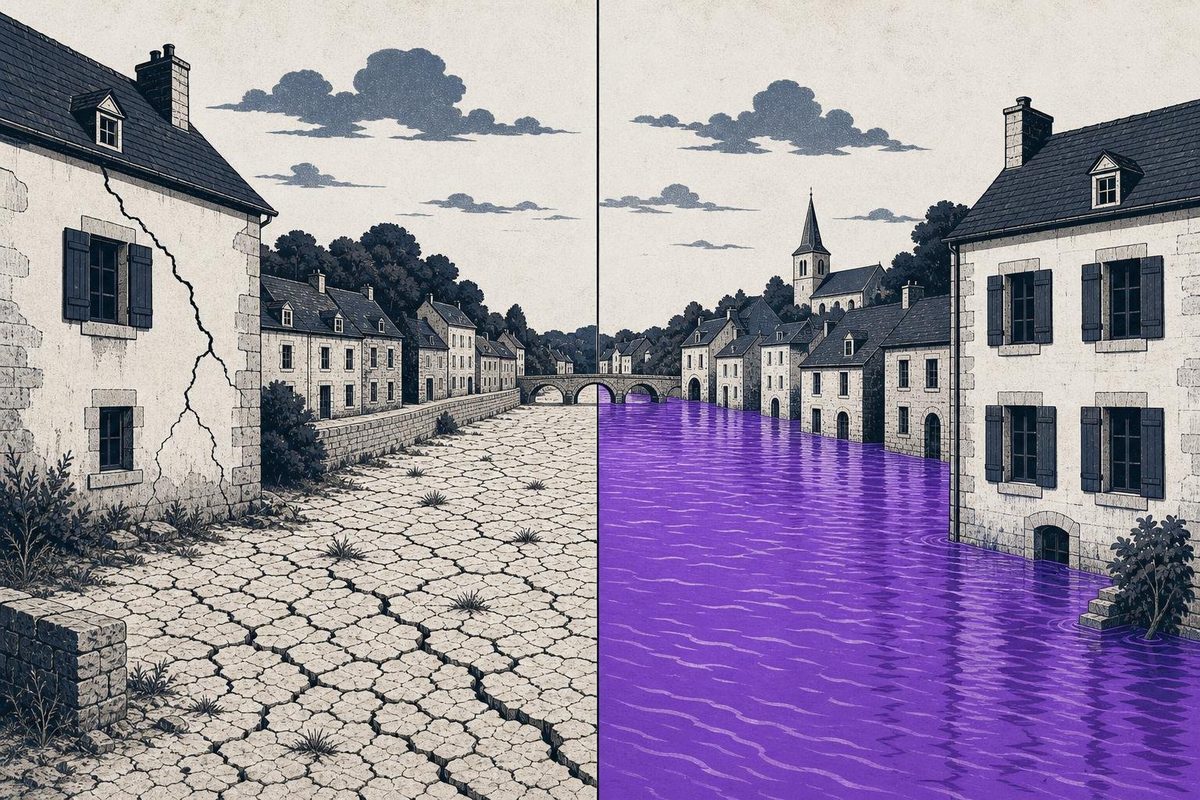
The cracks usually start above a door frame. A house on clay soil dries out over a hot summer, the ground shrinks unevenly, and by autumn a diagonal fissure runs from the corner of a window to the ceiling. In France this is not a building defect for the owner to absorb alone. It is a recognised natural catastrophe, retrait-gonflement des argiles (RGA), and since 1982 it has been insured through the same compulsory regime that pays for floods and earthquakes.
That regime, known as CatNat, now spends much of its money on drought. According to CCR, the state-owned reinsurer at its centre, floods account for 49% of the roughly €61.2bn of CatNat losses between 1982 and 2024, and drought for 41%. In 2022, the costliest year on record, claims came to nearly €3.9bn, more than 95% of them drought, as Banque des Territoires reported in June 2026.
The 1982 bargain
The régime d’indemnisation des catastrophes naturelles was created by the law of 13 July 1982 and is set out in article L125-1 and following of the Code des assurances. Its logic is a trade between the state and the insurance market.
Insurers must include CatNat cover in every contract that insures property against damage: homes, businesses, farm buildings and motor policies with fire or theft cover. They cannot refuse it, price it by risk or carve it out. In return, the state offers them a reinsurer it guarantees without limit. The Caisse Centrale de Réassurance (CCR) reinsures natural catastrophe risks “with the guarantee of the State”, in the words of article L431-9.
What is covered is defined by exclusion as much as by inclusion. The Senate’s finance committee, in the Lavarde report published on 15 May 2024, describes the regime as covering “uninsurable” perils: floods, earthquakes, cyclones in the overseas territories and clay shrink-swell subsidence. Storm, hail, snow and fire stay out, because ordinary property policies already cover them through the storm and fire guarantees.
How the price is set
CatNat has no premium of its own. It is a surcharge, a fixed percentage of the property-damage premium, and the state sets the rate.
| Policy type | Until 31 Dec 2024 | From 1 Jan 2025 |
|---|---|---|
| Home and business property | 12% | 20% |
| Motor (fire and theft cover) | 6% | 9% |
The increase was decided by arrêtés published on 28 December 2023, according to the Ministry of the Economy, which expected it to add about €1.2bn a year to the regime’s capacity. Some secondary sources date the decision to December 2024. That is the year it took effect, not the year it was decided.
An illustration helps. A household whose home policy carries a base property premium of €300 pays €60 for CatNat at the 20% rate, whether the house sits on a floodplain or on a hilltop. A neighbour with a €600 base premium pays €120. The surcharge follows the size of the policy, not the hazard. That is the solidarity principle in its plainest form, and it is the point critics attack first.
The surcharge rise has shown up quickly in CCR’s books. Its 2025 results, published on 23 February 2026, report gross premiums of €1,878m, 95.2% of them CatNat business, a net result of €536m, and an equalisation reserve rebuilt to €466m. CCR attributes €541m of additional resources to the higher surcharge.
Deductibles
Every CatNat claim carries a statutory deductible that the insurer cannot waive. According to Service-Public.fr, the official information service, it is €380 for a home and €1,520 for damage caused by drought and soil rehydration. The higher drought figure reflects how expensive and how frequent subsidence claims have become.
The decree that opens the door
The feature that most separates CatNat from schemes such as Spain’s Consorcio is the trigger. A French household cannot claim under the regime simply because its house was flooded. The state must first recognise a natural catastrophe.
The sequence, as Service-Public.fr sets it out:
- The affected commune applies for recognition.
- An inter-ministerial arrêté recognises the state of natural catastrophe for that commune, for a stated period and a stated type of damage, and is published in the Journal officiel.
- The policyholder has 30 days from publication to declare the claim to their own insurer, if not done before.
- The insurer must pay a provision within two months and settle within three months of receiving the estimate of damage.
For a fast, visible flood, recognition can come quickly. For drought it is slower and much less certain. Subsidence appears months after the dry spell, the scientific criteria for an abnormal drought are technical, and the Senate found that, on average, only about half of communes applying for drought recognition obtain it. Even inside a recognised commune, about half of individual drought claims are closed without payment after the insurer’s expert visit. A homeowner with a cracked wall can therefore pay the surcharge for decades and still receive nothing.
Who carries the losses
Insurers that cede to CCR usually take two layers of cover, as CCR describes on its guarantee page:
- a quota share of 50%, so that CCR takes half of every CatNat premium and half of every CatNat claim;
- an unlimited stop-loss on the share the insurer keeps, so that its annual CatNat losses above a threshold pass to CCR without a cap.
Behind CCR stands the State. The Senate’s report notes that the guarantee has been called only once, in 2000, after storms Lothar and Martin at the end of 1999. That record is reassuring and slightly misleading. The same report expected CCR’s equalisation reserve to be close to zero at the end of 2024, after the drought years, and projected that claims costs would rise by about 40% by 2050, or about 60% once growth in the value of exposed property is included.
A record of recent years
Annual insured CatNat damage is now regularly around €2bn, according to the Banque des Territoires analysis of June 2026. The years since 2022 read like a list of stress tests:
- 2022: nearly €3.9bn, the costliest year since 1982, more than 95% drought. AFP, citing CCR in October 2023, reported that the 2022 drought alone had been revised up to €3.5bn.
- 2023: CCR’s central estimate for drought was €900m, within a range of €750m to €1bn.
- 2024: total CatNat losses passed €2bn, according to CCR’s loss statistics.
- 2025: drought between €770m and €1bn, cyclonic winds between €340m and €480m, and flooding between €178m and €219m, as estimated by Banque des Territoires. On CCR’s own books the 2025 claims charge was €978m, including €241m for Cyclone Garance in Réunion and €482m for drought.
Floods have not gone away. They still make up almost half of the long-run total, and the protection gap data compiled by EIOPA give France a historical insured share of flood losses of 54%, far above the 26% recorded for Germany. EIOPA’s 2025 dashboard scores France’s current flood protection gap at 1.5 on a scale of 0 to 4, with a total of 6.5 across five perils.
What the Senate wants to change
The Lavarde report made recommendations that have shaped the debate since 2024:
- an automatic annual increase in the surcharge of 0.2 percentage points, so that the rate keeps up with claims without a political decision each time;
- a single deductible when the same property is hit by repeated events, instead of one per event;
- lower deductibles for policyholders who take prevention measures, which would create a link between price and behaviour that the regime lacks today.
None of these changes the basic architecture. They are adjustments to a scheme the report treats as worth keeping.
The criticisms
The Senate’s report is also the best single catalogue of what is wrong with CatNat, and it is not gentle.
Businesses feel short-changed. Companies pay the same 20% surcharge on their property premiums but tell the committee that the regime works better for households and is not transparent enough about how claims are decided.
Drought recognition is a lottery. With about half of commune applications refused and about half of individual claims closed without payment, the regime’s handling of RGA is its weakest point.
The money leaks. Part of the surcharge is taxed to fund the Barnier fund for prevention. The report found that the tax raised €273m while the fund received only €200m in credits, and that the tax could exceed €450m at the 20% rate.
No price signal. A flat surcharge means that building on shrinking clay or in a flood corridor costs the owner nothing extra in insurance. The report also judges the building standards for new homes on clay, introduced under the ELAN law, to be insufficient.
Sustainability. A reserve near zero at the end of 2024 and a projected 40–60% rise in claims costs by 2050 do not add up without further increases in the surcharge, which is why the automatic uprating idea exists.
Some figures that would help to judge the regime are not published in a usable form. France Assureurs’ report on home insurance in 2025 counts 46.3 million home insurance contracts at the end of 2025 but gives no coverage rate, so the share of households outside CatNat cannot be stated with confidence.
Where France sits among the schemes
France and Spain are often grouped together because both charge a flat compulsory surcharge on private policies. The difference is who pays the claim and when. A Spanish household claims directly from the Consorcio without any declaration of disaster, while a French one waits for a decree and claims from its own insurer. The Consorcio page explains the Spanish model, and the Flood Re page describes the British alternative, which has no state guarantee at all. The side-by-side comparison follows a single flooded house through the three systems, and the overview of European schemes places all six in their families.
The open question for France is drought. A regime designed in 1982 around floods and earthquakes now finds its future cost driven by the slow shrinking of clay under millions of houses, a peril whose damage is gradual, contested and hard to time. How the next surcharge decision handles that will matter more than any flood.
Sources
- Garantie Catastrophes Naturelles, CCR (undated)
- L'essentiel sur le contrôle budgétaire du régime d'indemnisation des catastrophes naturelles (rapport Lavarde), Sénat, commission des finances (2024-05-15)
- Publication des arrêtés renforçant les moyens d'action du régime d'indemnisation des catastrophes naturelles, Ministère de l'Économie et des Finances (2023-12-28)
- Catastrophe naturelle : quelle indemnisation par l'assurance ?, Service-Public.fr (DILA) (2026-04-10)
- CCR publie ses résultats annuels 2025, CCR (2026-02-23)
- La sinistralité en chiffres, CCR (undated)
- Catastrophes naturelles : la sécheresse à l'origine de la moitié des dégâts assurés en 2025, Banque des Territoires (Localtis) (2026-06-25)
- Assurance : le coût de la sécheresse attendu à 900 millions d'euros en 2023 (AFP, citing CCR), L'Info Durable / AFP (2023-10-17)
- L'assurance habitation en 2025, France Assureurs (2026)
- The dashboard on insurance protection gap for natural catastrophes in a nutshell (EIOPA-BoS-25/564), EIOPA (2025-11-10)
Frequently asked questions
How much does CatNat cover cost a French household?
There is no separate price list. The cover is charged as a surcharge equal to 20% of the property-damage premium on a home policy, a rate in force since 1 January 2025. A household paying more for its home insurance therefore pays more for CatNat in euros, but the percentage is the same in Paris, on the Loire floodplain or in a village on shrinking clay.
What if my commune is not recognised as a natural catastrophe?
Without an inter-ministerial decree covering the commune, the period and the type of event, the CatNat guarantee does not apply, and damage from flood or drought is paid only if the ordinary policy happens to cover it. The Senate's 2024 report found that, on average, only half of communes applying for drought recognition obtain it.
Are storms covered by CatNat?
In mainland France, no. Wind, hail and snow damage are covered by the ordinary storm guarantee in home and business policies, so they were left out of the regime. Cyclones in the overseas territories are a different matter: they fall under CatNat, and Cyclone Garance in Réunion cost CCR €241m in 2025.
Is CCR a private company?
CCR is a public limited company owned by the French State. Insurers may reinsure their CatNat business with it, and it offers a 50% quota share plus an unlimited annual stop-loss. It can offer cover without a ceiling because it holds a State guarantee under article L431-9 of the Code des assurances, called only once since the regime began.
Does CatNat cover businesses as well as homes?
Yes. The extension is compulsory in every policy covering damage to property, so it applies to shops, offices, factories and farms as well as homes, and to motor policies that include fire or theft cover. Businesses pay the same 20% surcharge on property premiums. The Senate's finance committee reported in 2024 that many businesses feel the regime works better for households than for them.