Malta: Europe's insurance hub with no national catastrophe scheme
Malta writes insurance for clients across the European Union from a country smaller than most European cities. At home, it has no compulsory natural catastrophe cover, no pool and no fixed rule for who pays when a storm hits.

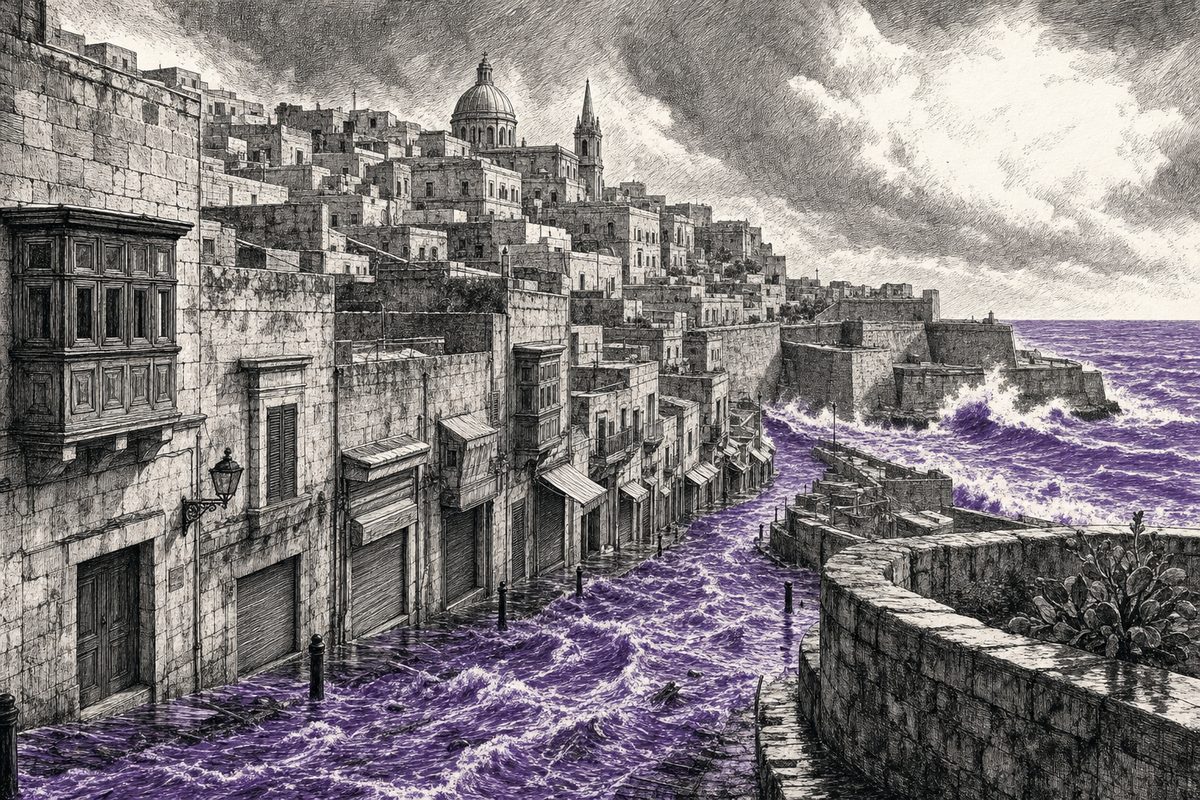
Storm Harry crossed the central Mediterranean between 19 and 21 January 2026, damaging farms and property across the Maltese islands. By the government’s own estimate the damage came to about €128 million, just above the €121 million threshold that allows a member state to apply to the EU Solidarity Fund. In July 2026 the European Commission approved an advance payment of €931,014 for Malta. Most of the bill was still being sorted out months later, through a patchwork of ministry grants, private policies and losses that nobody insured at all.
A country without a scheme
Every scheme on this site answers the same question in a different way: who pays for a natural catastrophe that private insurance alone will not carry? France answers with a compulsory surcharge and a state reinsurer, Spain with a public insurer, Norway with a pool shared by every insurer. Malta has not answered it.
There is no statute that makes natural catastrophe cover compulsory, no surcharge on property policies and no public body that takes on flood or storm risk. A homeowner or business that wants cover buys it from a private insurer, usually as part of an ordinary property policy, and many do not. The European Environment Agency’s figures on losses from 1980 to 2024 put the insured share in Malta below 3%, alongside Bulgaria, Croatia, Cyprus, Lithuania, Romania and Iceland. In Belgium, Denmark, France and the Netherlands, the figure is above 35%.
The gap does not come from a lack of insurers. It comes from what Malta’s insurers are for.
The passport economy
Malta joined the EU in 2004 and in the same year introduced legislation for protected cell companies, a structure that lets one licensed insurer host many ring-fenced cells, each with its own assets and liabilities. An MFSA director wrote in 2014 that Malta was the only full EU member state to offer such legislation. A cell can write business across the EU and EEA under the host company’s single-market passport, which is why brokers, affinity groups and insurtech start-ups have used Maltese cells rather than build a full insurer of their own. Industry figures put the number of insurance cells at 79 in 2023. These cells are regulated by the Malta Financial Services Authority and mostly insure risks far from the islands.
The same model built Malta’s other large regulated export. The Malta Gaming Authority’s 2025 annual report, published in July 2026, counted 302 licensed companies holding 311 licences and an estimated 15,039 people working for them in Malta. Gaming generated about €1.42 billion in gross value added, roughly 6.3% of GDP. Like the insurance cells, most of those licences serve customers abroad.
Both industries are passport businesses. They exist because a Maltese licence opens a much larger market, and they are regulated with that market in mind. Neither has much reason to build products for a domestic population of a little over half a million people living with storm and flood risk.
The gap shows most clearly in what a Maltese resident is protected against. Someone placing a bet online is covered by the Gaming Act 2018: operators must check that players are at least 18 before they can play, and offering games without a licence carries fines of €10,000 to €500,000 per infringement, as the rules for Maltese online gambling sites set out. The same resident, flooded out of a shop in Msida, has no statutory cover at all. Malta has written detailed protection for the products it sells abroad, and almost none for the risks its own households carry at home.
What Storm Harry showed
Without a scheme, the response to Harry was assembled after the event.
- Transport Malta opened a €1 million fund offering grants of up to €5,000 per applicant for damage from flooding, strong winds and similar causes. Fish farms, bus stops, solar panels, billboards and greenhouses were excluded.
- The Agriculture Ministry asked farmers to report damage through its Biedja Cam platform with geotagged photos, as the basis for an EU-backed aid scheme.
- The EU Solidarity Fund application, based on the €128 million estimate, produced the July advance. The final award depends on the Commission’s assessment.
The process drew criticism almost at once. The government’s plan to compensate businesses that had breached planning rules was attacked by commentators, and former prime minister Alfred Sant said that firms which had set up commercial facilities illegally should not receive public funds. Under a scheme with written rules, that question would have been settled before the storm.
A flooded shop in Msida
Take a hypothetical shop near the bottom of a valley road in Msida, where runoff from higher ground collects after heavy rain. A storm floods it and ruins €20,000 of stock and fittings.
If the owner bought a commercial property policy that includes flood, the insurer pays the claim less the deductible, and the matter ends there. If the policy excludes flood, or there is no policy, the owner looks for a grant. A scheme like Transport Malta’s might pay up to €5,000 if the damage fits its categories. Anything beyond that falls on the owner. In France or Spain, the same shop would be covered automatically through its ordinary policy. In Malta, the outcome depends on a choice made long before the storm, and on whichever fund the government opens afterwards.
Risks the islands carry
Malta’s exposure is narrower than Norway’s or Switzerland’s, but it is not small. Flash floods follow intense autumn and winter rain, when water runs down valleys that have been built over into roads and shops. Storms from the north and east drive waves onto exposed coasts and harbours. Seismic risk is real, if rare: the 1693 earthquake centred on Sicily destroyed the cathedral in Mdina, which was rebuilt in the following years.
The density of building on the islands makes each event more expensive. After Harry, a large share of the losses fell on farmers and small businesses, and much of the public response was aimed at them.
The criticisms
No rules in advance. Each event produces its own funds, each with its own eligibility list. Owners cannot know before a storm what they will receive after it.
Slow money. EU Solidarity Fund support arrives months after an event, and the advance for Harry was less than 1% of the estimated damage.
Aid without conditions. Paying out to businesses that ignored planning rules removes one of the few incentives to avoid building in exposed places.
An industry pointed outwards. Malta has the regulatory expertise to design a cell-based or parametric cover for its own residents, but its insurance sector is organised around clients elsewhere.
Malta among the schemes
Malta sits closest to the model of Germany and Austria described on our Germany and Austria page: a voluntary private market, followed by state and EU aid when the losses are large enough. The difference is scale. Germany’s state can fund reconstruction programmes in the tens of billions; Malta’s depends on threshold-based EU support for anything large. Our comparison of European schemes sets the models side by side, and the protection gap page shows how far Malta’s insured share sits from the rest of the EU.
Sources
- Storm Harry damage estimated at €128 million as Malta seeks EU aid, BusinessNow (2026)
- Agriculture Ministry launches damage assessment after Storm Harry hits farmers, MaltaToday (2026)
- Sant joins criticism of storm compensation for illegal businesses, MaltaToday (2026)
- Embracing Change: Regulatory Innovation, Malta Financial Services Authority (2014-11-19)
- Malta's insurance protected cells unlock EU and UK markets, Captive Review (undated)
- Annual Report 2025, Malta Gaming Authority (2026)
- Dashboard on insurance protection gap for natural catastrophes, EIOPA (undated)
Frequently asked questions
Is natural catastrophe insurance compulsory in Malta?
No. Malta has no law requiring flood, storm or earthquake cover and no national pool. Property owners who want cover buy it from private insurers, usually as part of an ordinary property policy, and many do not.
Who paid for the damage from Storm Harry?
A mix of private insurers, for owners with suitable policies, government grant schemes such as Transport Malta's €1 million fund, an aid scheme for farmers and an application to the EU Solidarity Fund, which approved an advance of €931,014 in July 2026.
Why does Malta have so many insurers if few residents are insured?
Most Maltese insurers and protected cells write business elsewhere in the EU and EEA under a single-market passport. They are based in Malta for its regulation and legislation, not to serve the domestic market.
What is a protected cell company?
An insurer whose business is split into ring-fenced cells, each with its own assets and liabilities. A cell can be used by a third party, such as a broker or manufacturer, to write insurance without setting up a full insurer. Malta introduced cell company legislation in 2004.
Could Malta set up a scheme like Spain's or France's?
In principle, yes, either through a surcharge on property policies or a public insurer. Malta's small size would make it more reliant on reinsurance, and a parametric scheme paying out on measured rainfall or wind speed is another option often discussed for small states.