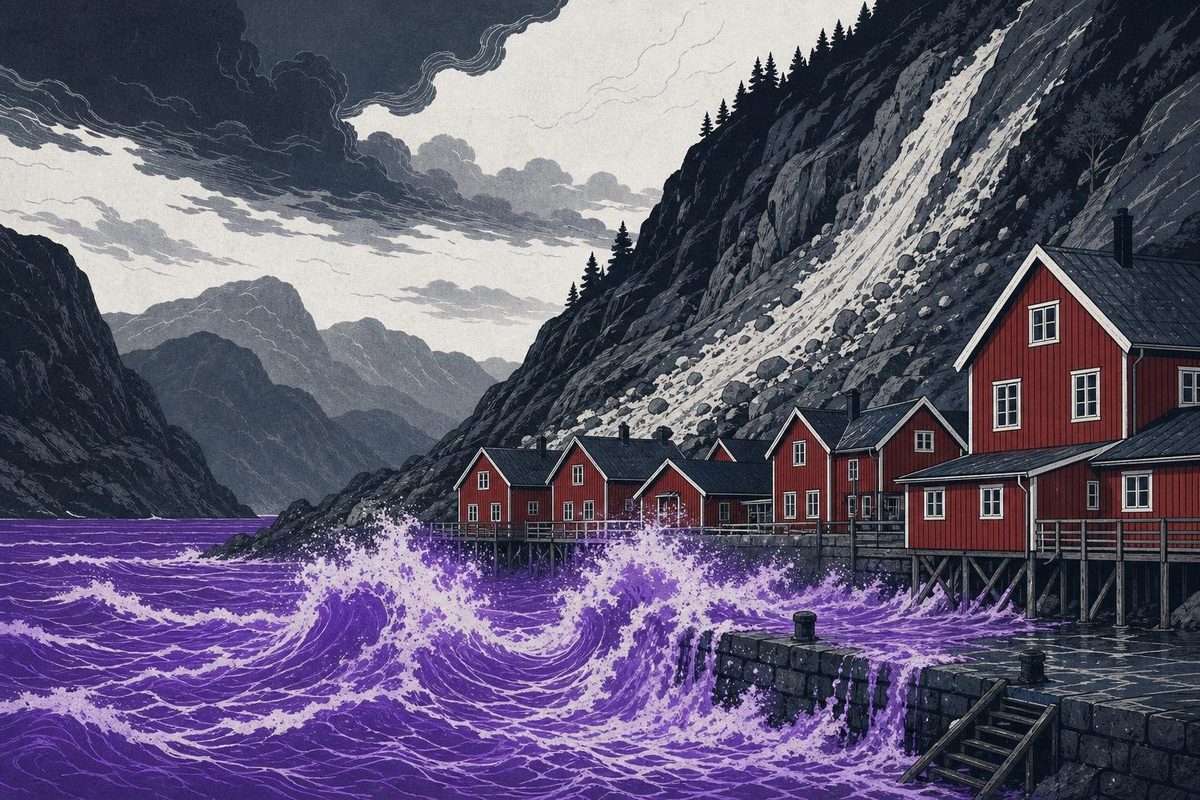
The Norwegian Natural Perils Pool and the state natural perils scheme
In Norway, every fire insurance policy automatically covers storms, floods and landslides through a pool shared by all insurers. What no policy can cover, from farm roads to quays, falls to a separate state scheme.

Storm Amy crossed Norway in October 2025 and left about 14,000 insurance claims behind it. The Norwegian Natural Perils Pool’s annual report for 2025 puts the cost at about NOK 1.8bn, most of the NOK 2.948bn of natural perils claims in a year that ended with a deficit of about NOK 655m. None of the households that claimed had bought storm cover. They had bought fire insurance, and in Norway that is the same thing.
Two schemes, one country
Norway runs two separate arrangements for natural hazards, and the first thing anyone dealing with damage has to work out is which one applies.
| Norsk Naturskadepool (the Pool) | Statens naturskadeordning (the state scheme) | |
|---|---|---|
| Legal basis | Natural Perils Insurance Act 1989; Regulation FOR-2024-01-26-111, in force 1 Jan 2025 | Naturskadeerstatningsloven 2014, in force 1 Jan 2017 |
| Run by | The insurance industry, through the Pool | Landbruksdirektoratet (Norwegian Agriculture Agency) |
| Covers | Anything insured against fire: buildings, contents, machinery, installations | Private property that cannot be insured: roads, bridges, farm and forest land, quays |
| Funded by | Natural perils premium on fire policies | The state budget |
| How to claim | Through one’s own insurer | Application to Landbruksdirektoratet |
The division is clean on paper. A house damaged by a landslide is the Pool’s business; the private road leading up to it, washed out by the same slide, belongs to the state scheme. Store norske leksikon, the Norwegian encyclopedia, describes the state scheme as covering only what cannot be insured. For a farmer whose barn, fields and access track are all hit in one night, that can mean two claims to two institutions under two laws.
How the Pool came about
The Pool started work on 1 January 1980, after a decision taken in 1979, according to its own history. Its basis today is the Natural Perils Insurance Act of 16 June 1989 and a new regulation of 26 January 2024, which entered into force on 1 January 2025.
The principle is compulsion through bundling. Every fire insurance policy covering property in Norway automatically includes natural perils cover, and every company that sells fire insurance in Norway and Svalbard must be a member of the Pool. The 2025 annual report counts 90 members. Nobody chooses to join, and nobody can sell fire cover without the natural perils part attached.
According to Finans Norge, the industry association, the covered perils are:
- storm;
- landslide (skred);
- flood;
- storm surge;
- earthquake;
- volcanic eruption.
The total fire sum insured across the country was about NOK 30,000bn at 1 July 2025, the annual report says. That figure is, in effect, the exposure base of the whole system.
One premium for every address
The Pool’s board sets a single natural perils premium as a share of the fire sum insured. For both 2025 and 2026 the rate is 0.08‰, and it is the same for a seafront house in the west and a flat in Oslo.
A hypothetical example shows the scale. A family home with a fire sum insured of NOK 5,000,000 pays NOK 400 a year for natural perils cover at 0.08‰, collected by its insurer with the fire premium. A house twice as valuable pays twice as much, wherever it stands. Earlier rates are reported differently by different sources, so only the current figure is given here.
Spain’s Consorcio charges a rate of the same order, 0.07‰ of the sum insured on homes, and it too ignores location. The comparison has limits: Spain covers political risks as well as natural ones, and it treats storm as extraordinary only when gusts pass 120 km/h, while Norway includes storm as such. Both, however, reach every insured property in the country at a single rate, and both measure it against the value insured, not against the premium as France does.
The uniform rate is a deliberate expression of solidarity. It is also the feature that draws the most criticism, as discussed below.
How losses are shared
The Pool does not pay claims itself. Each member insurer settles its own customers’ claims and the Pool then equalises the cost between members by market share, so that an insurer with many customers in a storm-hit county does not carry more than its share of the national loss.
On top of that sits a reinsurance programme, described in the 2025 annual report:
- Retention. The first NOK 2bn of a loss is kept within the Pool.
- Excess of loss. Reinsurance covers losses above the retention up to the regulatory limit of liability of NOK 16bn per event.
- Quota share. A 50/50 quota share sits alongside, ceding half of the retained risk to reinsurers. The annual report says that without it the 2025 result would have been about NOK 500m weaker.
The same structure was kept for 2026. The Pool is also building up central natural perils capital towards NOK 4bn. What happens above NOK 16bn is less clear: no explicit state guarantee for losses beyond the limit has been published.
From claim to payment
For an insured household, the route is the same as for any other claim. The policyholder reports the damage to their own insurer. The insurer handles the case and, if the damage was caused by one of the covered perils, books it to the Pool, which decides whether the event counts as a natural peril and equalises the cost.
The state scheme works differently. Owners apply to Landbruksdirektoratet. Compensation is paid only when restoration of the damaged property is documented, and the right lapses if the property is not restored within three years. That design rewards repair, but it also means the owner may have to pay for the work before the state pays the owner.
A landslide, two claims
Consider a hypothetical smallholding on a valley side in western Norway. After days of heavy rain, a slide comes down the slope. It pushes into the back wall of the farmhouse, buries part of a hayfield and carries away a section of the private gravel road that is the only access to the property.
The farmhouse is insured against fire, so its natural perils cover is automatic. The owner reports the damage to the insurer, the insurer assesses it, and the Pool confirms that a landslide is a covered peril. Repairs to the house are paid under the policy, at no extra premium beyond the NOK 0.08 per NOK 1,000 of fire sum insured the owner has been paying all along.
The hayfield and the road are a different matter. Neither can be insured against natural perils in Norway, so the owner applies to Landbruksdirektoratet under the state scheme. The application can succeed, but the money arrives only once the owner documents that the field and the road have been restored. If the restoration has not been carried out within three years, the right to compensation lapses.
Two institutions, two laws and two timetables, for one slide on one night. That, more than any statistic, is what the Norwegian split between insurable and uninsurable property means in practice.
Recent losses
Norway’s recent record shows how much weather can vary from one year to the next.
- Extreme weather Hans, August 2023. About 10,000 claims were reported initially, according to the Pool. The estimate of the final cost was raised to NOK 3.1bn at 31 December 2025, from NOK 2.4bn a year earlier.
- Storm Amy, October 2025. About 14,000 claims and about NOK 1.8bn.
- 2025 as a whole. About NOK 2.948bn of claims and a deficit of about NOK 655m.
Hans is a useful reminder that early estimates in a natural catastrophe tend to move upwards. A rise of NOK 0.7bn in a single year on an event already two years old is large for a pool of this size.
EIOPA’s dashboard on the insurance protection gap, in its 2025 update, gives Norway a total score of 5 out of a possible 20, with a current flood score of 1 on its 0–4 scale. The historical insured share of Norwegian flood losses in the same dataset is 50%. The protection gap page explains what those scores measure and why the historical figure differs from the current one.
Supervision and reform
Two changes have reached the Pool in quick succession. The new regulation took effect on 1 January 2025, and from 1 January 2026 the Pool has been under the supervision of Finanstilsynet, the Financial Supervisory Authority of Norway. The annual report also notes that the Ministry of Justice is still working on the responses to a 2024 consultation on a new Act, and that further changes are expected.
The criticisms
The Norwegian model is stable and widely accepted, but three lines of criticism keep coming back.
No incentive to prevent damage. A Norges Bank staff memo published on 8 January 2026, which mapped homes in areas exposed to weather-related risks, notes that a uniform premium that does not respond to risk weakens the incentive for owners in exposed places to invest in prevention.
A price set by the industry. Hans Jacob Bull, writing on the Norwegian model in Scandinavian Studies in Law in 2018, argues that a fixed premium for all properties hampers competition between insurers, and that the rate is set by the insurers through the Pool with no insight for policyholders.
Rebuilding the same risk. Bull also points to the lack of mechanisms that would push owners to prevent damage or rebuild in a safer way. He notes that a 2017 law committee was not allowed to review the solidarity principle at all, which took the most important question off the table before the review began.
To these can be added the practical friction of the two-track system. The legal line between insurable and uninsurable property is clear, but for someone standing in front of a damaged farmyard it is not always obvious which institution to call first.
Norway among the schemes
The closest relative of the Norwegian Pool is the private side of the Swiss system, where insurers must include natural perils in fire cover, charge a single tariff and share claims through the Elementarschadenpool; the Switzerland page describes it. Spain also uses a flat rate on the sum insured, but through a public body that pays claims directly, as the Consorcio page explains. The comparison of European schemes lines up all six on pricing, compulsion and who carries the extreme losses, and the schemes overview groups them by model.
One number in the Pool’s report deserves more attention than it gets. The limit of liability is NOK 16bn per event; the largest event of recent years, Hans, is estimated at NOK 3.1bn. The gap between the two is the margin Norway is counting on, and nobody has yet had to find out what lies above it.
Sources
- Annual Report 2025, Norwegian Natural Perils Pool (unofficial translation), Norsk Naturskadepool (2026)
- About the Norwegian Natural Perils Pool, Norsk Naturskadepool (undated)
- Around 10,000 reported claims after extreme weather Hans, Norsk Naturskadepool (2023)
- Slik forsikrer vi oss mot naturskader, Finans Norge (undated)
- naturskadeerstatningsloven, Store norske leksikon (undated)
- Staff Memo 12/2025: Damage caused by weather and climate change, identifying homes in areas exposed to weather-related risks in Norway, Norges Bank (2026-01-08)
- Natural Damage Insurance: The Norwegian Model (Hans Jacob Bull), Scandinavian Studies in Law vol. 64, Stockholm Institute for Scandinavian Law (2018)
- The dashboard on insurance protection gap for natural catastrophes in a nutshell (EIOPA-BoS-25/564), EIOPA (2025-11-10)
Frequently asked questions
Do I need to buy natural perils insurance separately in Norway?
No. If a building or its contents are insured against fire, the natural perils cover is included automatically and cannot be removed. The insurer collects a uniform natural perils premium with the fire premium and passes the risk to the Norwegian Natural Perils Pool, of which every fire insurer operating in Norway and Svalbard must be a member.
Is a damaged private road covered by insurance or by the state?
Usually by the state scheme. A private road, a bridge, farmland, forest land or a quay generally cannot be insured against natural perils in Norway, so damage to them falls under the state natural perils scheme administered by Landbruksdirektoratet. The owner applies there rather than to an insurer, and compensation is paid once restoration of the damaged property is documented.
Who supervises the Norwegian Natural Perils Pool?
Since 1 January 2026 the Pool has been supervised by Finanstilsynet, the Financial Supervisory Authority of Norway. Its rules come from the Natural Perils Insurance Act of 1989 and a regulation that took effect on 1 January 2025. The Ministry of Justice is still working through responses to a 2024 consultation on a new Act, so further changes to the framework are expected.
How big a disaster could the pool pay for?
The regulatory limit of liability is NOK 16bn per event, and the pool's reinsurance is arranged to cover losses up to that level, above a NOK 2bn retention. The largest recent event, the extreme weather Hans in August 2023, was estimated at NOK 3.1bn at the end of 2025. No event of recent years has come close, and no explicit state guarantee for a larger one has been published.
Who sets the natural perils premium in Norway?
The board of the Norwegian Natural Perils Pool sets one rate for the whole country, expressed as a share of the fire sum insured. For both 2025 and 2026 it was 0.08 per mille. Policyholders have no say in it, and legal scholars have criticised the arrangement for leaving the price to the insurers acting together.