Iceland Volcano Case Study: Eyjafjallajökull 2010, the Ash Cloud and Europe's Air Traffic
A moderate eruption under an Icelandic ice cap grounded a large share of the world's flights for a week in April 2010. Almost none of the cost was insured, and the bill landed in unexpected places.

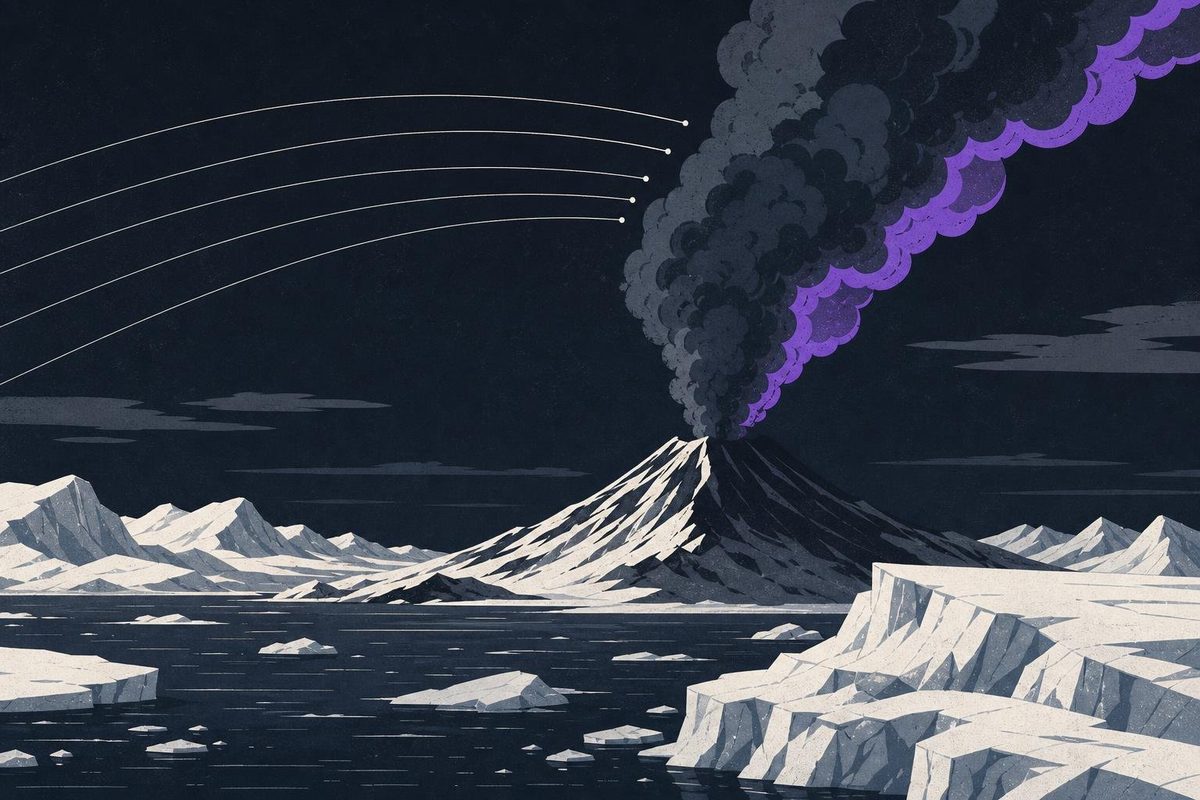
At 01:15 UTC on 14 April 2010 an eruption broke through roughly 200 metres of ice inside the summit caldera of Eyjafjallajökull, in southern Iceland. By the evening the plume stood 9 to 10 kilometres above sea level, and north-westerly winds were pushing fine ash towards the British Isles and Scandinavia. Within four days a large part of European airspace was closed.
The volcano was not especially violent. The Icelandic Meteorological Office (IMO) and its partner institutes, in their 2012 report to the International Civil Aviation Organization, rate it at 3 on the Volcanic Explosivity Index and describe it as “of a moderate size”. What made it expensive was the combination of very fine ash, a steady wind towards the busiest airspace on the continent and a rulebook that, in April 2010, treated any forecast ash as a reason to stop flying. That combination is why the event became a standard Iceland volcano case study in risk management courses, and why the EU-funded ENHANCE project chose it as one of its ten case studies.
This Iceland volcano case study covers the eruption itself, the airspace closures, the three loss figures that are usually quoted (and what each one actually measures), who ended up paying, and what the ENHANCE researchers at the University of Iceland examined.
Eyjafjallajökull in 2010: two eruptions and four phases
There were in fact two eruptions. The first, a flank eruption on the Fimmvörðuháls pass between the Eyjafjallajökull and Mýrdalsjökull ice caps, began on 20 March and stopped on 12 April. It produced lava, attracted sightseers and caused no trouble for aircraft. A day and a half after it ended, the summit eruption started under the ice. The IMO report divides it into four phases:
- Phase I, 14–18 April. Ash-rich and explosive, the most powerful part of the eruption. Meltwater mixing with magma shattered it into exceptionally fine particles: in this phase as much as half the erupted material was ash smaller than 63 micrometres.
- Phase II, 18 April – 4 May. Lower output and a mixed effusive and explosive style. A lava flow melted its way about 3 kilometres down an outlet glacier.
- Phase III, 5–17 May. A second explosive phase, preceded by a day or two of inflation and deep earthquakes, which brought a new round of disruption to flights.
- Phase IV, 18–22 May. Declining activity until the eruption ended, with minor activity near the craters on 4–8 June and 17 June.
In total the eruption produced about 0.27 cubic kilometres of tephra. About half fell on land in Iceland and about half in the ocean to the south and south-east; the report notes that only “a tiny fraction” reached Europe. The plume never rose above 10 kilometres and was usually between 4 and 8 kilometres high, often bent over by the wind.
On the ground in Iceland the response worked. Risk assessments and response plans for the area had been completed in 2005, followed in 2006 by an awareness campaign and evacuation drills involving everyone in the threatened zones. During the eruption, according to the IMO report, the plan “proved successful with respect to evacuations and other planned mitigation measures”. The local hazard was managed. The continental one was not.
How the ash cloud shut down Iceland volcano air traffic in April 2010
The Iceland volcano air traffic crisis came from a precautionary rule meeting an unusual weather pattern. Jet engines that ingest volcanic ash can fail: the glassy particles melt in the hot section and coat the turbine, and ash also abrades windscreens and reduces visibility. Before 2010 the guidance was simple. If ash might be present, the airspace closed.
EUROCONTROL’s June 2010 analysis gives the scale. Over the eight days from 15 to 22 April, 104,000 flights were cancelled, 48% of the traffic that would normally have flown, and on 18 April the figure reached 80%. Another 7,000 flights were cancelled in May, during the second explosive phase. About 10 million passenger journeys were disrupted. The UK, Ireland and Finland were among the countries hit hardest in April.
IATA’s economic briefing of May 2010 adds the global view. At the peak, on Sunday 18 and Monday 19 April, around 19,000 flights a day were cancelled, which grounded just under 30% of the world’s scheduled passenger capacity. More than 1.2 million scheduled passengers a day were affected. European airlines accounted for 70% of the grounded capacity, and at the height of the closures the European airline industry had 75% of its operations shut. The single most valuable market lost was UK–United States, worth about USD 25m of scheduled passenger revenue a day.
The closures did not end because the ash went away. The IMO report records that European aviation rules on permissible ash concentration were changed on 19 April 2010, and that this change reopened commercial routes. In other words, a regulatory decision about tolerable risk, taken in the middle of the crisis, did more to restore Iceland volcano air traffic than any change in the volcano.
Three loss figures that measure different things
Three numbers circulate for the cost of the event, and they are often quoted as if they were alternative estimates of the same thing. They are not.
| Figure | Who produced it | What it measures |
|---|---|---|
| USD 1.7bn | IATA, May 2010 | Lost airline revenue from scheduled passenger and cargo services over the closure period |
| USD 4.7bn | Oxford Economics, study for Airbus, June 2010 | Impact on global GDP for the week of flight disruption |
| EUR 2.7bn | EUROCONTROL, 2021 retrospective | Economic loss of the 2010 crisis as quoted by EUROCONTROL and the European Commission |
IATA’s USD 1.7bn is a bottom-up estimate built from passenger and revenue data for thousands of country pairs. It started at about USD 200m a day and rose to about USD 400m a day at the peak. It is revenue foregone by airlines, before any costs they saved by not flying and before the costs of caring for stranded passengers.
The Oxford Economics figure of USD 4.7bn is broader. Adrian Cooper, head of Oxford Economics, presented the study for Airbus at the World Travel and Tourism Council summit in Beijing in June 2010, as reported by eTurboNews on 7 June 2010. It counts the hit to output across the economy: perishable exports that could not be flown (USD 65m in Africa alone), more than USD 100m in electrical parts and equipment, and USD 280m to USD 700m in productivity lost by stranded workers. Europe bore most of it. A further 5,000 cancellations in May added about USD 250m, bringing the study’s total to about USD 5bn.
EUROCONTROL’s EUR 2.7bn, quoted in its 2021 retrospective, is the figure European institutions tend to use. The same article counts nearly 8 million stranded passengers, a lower number than the 10 million disrupted journeys in its 2010 analysis; the two count different things too.
What none of the three is: an insured loss. No published insured-loss figure for the ash cloud has been found.
Who paid: airlines, passengers and EU law
Most of the bill stayed where it fell. Airlines lost the revenue. Businesses that depended on air freight lost sales. Travellers paid for extra nights, trains and ferries, and many recovered part of it later.
The rules that decided much of the split were in EU Regulation (EC) No 261/2004 on air passenger rights. The closure counted as an “extraordinary circumstance”, so airlines did not owe the fixed cash compensation the regulation provides for many cancellations. They did owe care: meals, refreshments and accommodation while passengers waited for a new flight. Some carriers argued that an event of this size should release them from that duty too. The Court of Justice of the EU disagreed. In McDonagh v Ryanair (case C-12/11, 31 January 2013), it held that the airspace closure was indeed an extraordinary circumstance, refused to create a separate category of “super extraordinary” events, and ruled that the duty of care has no temporal or monetary limit.
The effect was a transfer of risk by law. An airline that sells a ticket carries the cost of looking after its passenger when a volcano in another country grounds the flight. That is a defensible choice, since the airline is better placed than a stranded family to absorb the cost, but it was made by regulation and courts, not by a pricing decision anyone took in advance.
Governments carried some of it. The Commission pointed Member States to Article 107(2)(b) of the Treaty on the Functioning of the EU, which allows state aid to make good damage caused by natural disasters or exceptional occurrences, and according to ASIL several Member States adopted aid measures for airlines. The total paid under those measures could not be verified from primary sources.
Why insurance covered so little
The protection gap after Eyjafjallajökull is close to total, and the reasons are structural rather than accidental.
First, there was almost no physical damage outside Iceland. Property insurance pays for damage to property. Business interruption cover is normally attached to a property policy and responds when insured damage stops the business. An airline whose aircraft sit undamaged on the apron, or a flower exporter whose warehouse is intact, has lost money without suffering the kind of loss those policies are written for.
Second, the trigger was a decision. Airspace closed because aviation authorities closed it. Losses caused by an authority’s order, without damage, sit in a grey zone that standard wordings tend to exclude, and the 19 April rule change showed how much the size of the loss depended on that decision rather than on the ash itself.
Third, the event was correlated across a whole market. Every European airline, freight forwarder and tour operator was hit in the same week. That is the profile insurers find hardest to price and reinsurers most expensive to carry. The site’s page on the insurance protection gap explains why correlated, low-frequency losses tend to stay uninsured, and the parametric insurance page describes the kind of contract (payment on a measured trigger such as ash concentration or hours of closure) that could in principle cover this sort of loss.
What the ENHANCE Iceland volcano case study examined
ENHANCE (2012–2016), a research project funded under the EU’s Seventh Framework Programme with grant agreement 308438, built its work around ten case studies of partnerships between public bodies, companies and civil society. The Eyjafjallajökull eruption case study, titled “Air industry response to volcanic eruptions”, was led from the University of Iceland, with Guðmundur Freyr Ulfarsson named as contact. It was classed as an EU-wide case and its partnership type as a risk reduction strategy.
The researchers started from the April 2010 eruption, which the case-study page described as closing European airspace for several days with losses estimated at USD 5 billion, a figure in line with the Oxford Economics total once the May disruption is included. The stakeholders listed were the organisations that actually made or carried the decisions in 2010:
- the Icelandic Meteorological Office, which monitored the volcano and reported on the plume;
- the London Volcanic Ash Advisory Centre (VAAC), which issued the ash forecasts for the region;
- the Central Flow Management Unit of EUROCONTROL, which managed traffic flows across Europe;
- the European Commission’s Directorate-General for Mobility and Transport;
- representatives of airlines.
The Eyjafjallajökull eruption case study had three lines of work. It analysed how procedures changed after 2010, in particular the ash-concentration thresholds and no-fly zones and the rules for restricted flight operations. It interviewed people at the VAAC, at airlines and in air traffic control about how decisions were taken and communicated. And it built risk scenarios, including the 2011 eruption under Vatnajökull and a possible large eruption of Katla within the next 100 years. Its stated aims were better regulation, better decision-making and better communication between stakeholders, plus a look at alternative transport plans for when aircraft cannot fly. The page also mentioned a video interview with Uta Reichardt of the University of Iceland and two Icelandic-language publications from 2015 and 2016.
Readers who come to the Iceland volcano 2010 case study through ENHANCE will find the full list of the project’s cases, from storm surges on the Wadden Sea to drought in the Júcar basin, on the case-study atlas, and the consortium of 24 partners, including Háskóli Íslands (the University of Iceland), is listed on the partners page.
Lessons for risk partnerships after 2010
The Iceland volcano 2010 case study is a useful corrective to the idea that disaster risk is mostly about physical damage. Four points stand out.
The partnership was the risk. In 2010 the people who forecast the ash, the people who closed the airspace and the people who lost money were in different organisations with different incentives. Forecasters had no reason to accept uncertainty, regulators faced the whole blame for any accident, and airlines carried the cost of every closure. The ENHANCE interviews were aimed at exactly this gap between who decides and who pays.
Rules can move the loss. The change on 19 April 2010, and the later shift described by EUROCONTROL, did more to limit losses than any engineering measure. According to EUROCONTROL’s 2021 retrospective, a European Aviation Crisis Coordination Cell was set up in 2011, bringing together the Commission, EUROCONTROL, Member States, EASA, air navigation service providers, airports, airlines and the military. Most states now use a safety risk assessment that keeps airspace open and leaves the decision to fly with the airlines. EUROCONTROL estimates that a similar eruption today would cancel up to 50,000 flights, affect 3.6 million passengers and cost EUR 1.5 billion less than in 2010.
That shift moves risk as well as reducing it. If airlines decide whether to fly, airlines and their insurers carry more of the safety risk. Whether that is a better allocation is a real argument, not a settled one.
Unplanned cost sharing is still cost sharing. Passenger-rights law and state-aid rules decided who paid in 2010, but nobody priced that allocation in advance. A risk partnership that agrees the split beforehand, as the national schemes on the schemes comparison do for floods and earthquakes, at least lets each party see its share. For volcanic ash, no such arrangement exists in Europe.
Four years later the same system was tested again. In late August 2014 the IMO raised the aviation colour code to red over Bárðarbunga, north of Vatnajökull, after a fissure eruption began in the lava field there. Icelandic air traffic control closed only the airspace above the site, up to 5,000 feet, and no ash was detected. A short ENHANCE news item from 29 August 2014 reported the alert and pointed readers back to this Iceland volcano case study.
Sources
- The 2010 Eyjafjallajökull eruption, Iceland: Report to ICAO, Icelandic Meteorological Office, Institute of Earth Sciences (University of Iceland) and Icelandic civil protection (2012-06)
- Ash-cloud of April and May 2010: Impact on Air Traffic, EUROCONTROL (2010-06)
- 11 years after the eruption of Icelandic volcano Eyjafjallajökull, EUROCONTROL (2021-11-17)
- IATA Economic Briefing: The impact of Eyjafjallajokull's volcanic ash plume, IATA (2010-05)
- Iceland volcanic ash affected more sectors than global aviation, Oxford Economics head says, eTurboNews (reporting the Oxford Economics study for Airbus) (2010-06-07)
- Case C-12/11 Denise McDonagh v Ryanair Ltd, judgment of 31 January 2013, Court of Justice of the European Union (EUR-Lex) (2013-01-31)
- The European Volcanic Ash Crisis: Between International and European Law, American Society of International Law (ASIL Insights) (2010)
- CORDIS: ENHANCE project record (grant 308438), CORDIS, European Commission (2016)
Frequently asked questions
Why did a small eruption cause such large disruption to air traffic?
Size was not the issue. The Icelandic Meteorological Office rates the 2010 eruption at VEI 3, a moderate event, but its ash was unusually fine and north-westerly winds carried it straight towards the busiest airspace in Europe. In April 2010 the rule was to close airspace wherever ash was forecast, so a modest plume over the North Atlantic translated into closures from Ireland to Finland.
Did passengers receive compensation for flights cancelled by the ash cloud?
Not the fixed cash compensation that EU Regulation 261/2004 provides for many cancellations, because the closure counted as an extraordinary circumstance. Airlines still had to provide care: meals, refreshments and hotel rooms for stranded passengers. In McDonagh v Ryanair (2013) the EU Court of Justice held that this duty has no time or money limit, even in an event of this scale.
How much did the Eyjafjallajökull ash cloud cost?
There is no single figure, because studies measured different things. IATA put lost airline revenue from scheduled passenger and cargo services at USD 1.7bn. Oxford Economics, in a study for Airbus, estimated a USD 4.7bn hit to global GDP for the week of disruption. EUROCONTROL later quoted EUR 2.7bn as the economic loss. None of these is an insured-loss figure.
Could the same thing happen again?
Iceland has many active volcanoes, and the ENHANCE case study built a scenario for a large Katla eruption. What has changed is the response. EUROCONTROL says most states now apply a safety risk assessment that keeps airspace open and leaves the decision to fly with airlines, and estimates that a repeat of 2010 would cancel up to 50,000 flights, about half the original number.
Was any of the loss covered by insurance?
Very little, as far as published sources show. No insured-loss figure for the event has been found. Most of the cost was lost revenue and lost output rather than physical damage, and conventional property and business interruption policies are built around damage. Some Member States used EU state-aid rules to support airlines instead.