Naturskaderådet: how Denmark pays for storm surges
Every Danish home with fire insurance pays the same 40 kroner a year towards storm surge and flooding, whether it stands on a dune or on a hill. The flat fee is simple and cheap, and since the storm surges of 2023 it has not been enough.

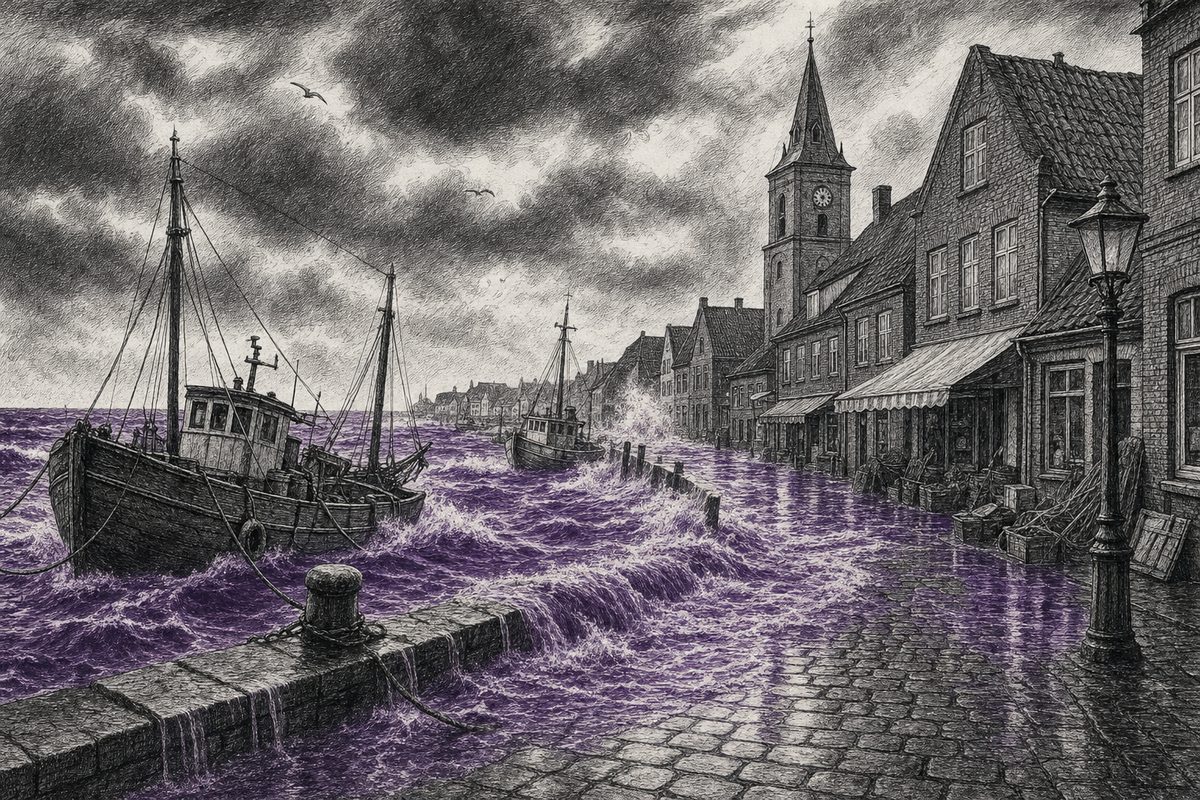
On 20 and 21 October 2023 a storm in the western Baltic pushed water into the fjords and harbours of southern Denmark. Streets in Aabenraa, Lolland and Falster went under. Two months later a second storm surge followed. Together the two events left the national storm surge scheme facing compensation provisions of about DKK 770 million, far more than it held. In May 2024 the government asked Parliament to raise the state guarantee behind the scheme from DKK 200 million to DKK 1 billion, a ceiling that will stay in place until 2033.
Two kinds of storm damage
Denmark splits storm losses in two. Wind damage and cloudburst flooding are covered by ordinary private home and building insurance, priced and paid by the insurer. Damage caused when the sea rises over the coast, or when streams and lakes burst their banks, is generally excluded from private policies. That second category is handled by a public scheme under the Act on certain natural disasters.
The scheme is administered by Naturskaderådet, the Danish Natural Hazards Council, which was known for years as Stormrådet. It runs two pools: one for storm surge and flooding from streams and lakes, and one for windfall in private forests.
A flat fee on every fire policy
The pools are funded by a fee collected with every fire insurance policy in Denmark. Insurers add it to the premium and pass it on.
| Element | Amount per policy per year | Goes to |
|---|---|---|
| Storm surge and flooding | DKK 30 | Storm surge pool |
| Windfall | DKK 10 | Windfall pool |
| Total | DKK 40 | Unchanged since the second half of 2021 |
The fee raises roughly DKK 200 million a year; the council’s 2023 annual report recorded DKK 192.8 million collected. Because the cover is tied to fire insurance, which almost every property owner has, take-up is close to universal without any separate obligation to buy.
The fee does not vary with exposure. A flat in central Copenhagen pays the same as a holiday home behind the dunes on the west coast of Jutland.
From claim to payment
Compensation is not automatic. Naturskaderådet first decides whether an event counts as a storm surge or a flood under the law, area by area. Once it has, owners in the affected areas can claim through their own insurer, which assesses the damage and passes the claim to the council.
The scheme pays for physical damage to buildings and contents. It does not cover indirect losses, so a business that has to close for weeks after a flood receives nothing for lost trading.
A harbour shop in Aabenraa
Take a hypothetical shop on the harbour front in Aabenraa during the October 2023 surge. Seawater comes in at floor level and ruins stock and fittings worth DKK 300,000.
Because the shop’s building and contents carry fire insurance, they are automatically part of the storm surge scheme. Once Naturskaderådet declares the event a storm surge for that stretch of coast, the owner claims through the insurer and is compensated for the physical damage. The two weeks the shop stays closed while it dries out are not covered. If the same shop had been damaged by wind or a cloudburst instead, the claim would have gone through the ordinary policy, on that policy’s terms.
Recent losses
- October 2023: the Baltic storm surge hit southern and eastern Denmark, the most damaging event in the scheme’s recent history.
- December 2023: a second storm surge added to the claims. Provisions for the two events reached about DKK 770 million.
- May 2024: the state guarantee was raised temporarily to DKK 1 billion, until 2033, because the pool could not cover its liabilities.
- April 2025: the responsible ministers wrote that the financing model was unfair and the amount collected insufficient, and that it had to change.
The criticisms
No price signal. Det Miljøøkonomiske Råd, the government’s environmental economics council, argued in its December 2024 report that every owner pays the same fee whether they live inland or on the outermost dune. It proposed risk-based premiums instead.
No incentive to adapt. The same report noted that the flat fee gives households no financial reason to protect their homes, at a time when a surge like October 2023’s is expected to become roughly a ten-year event by 2070.
Too small a pool. At around DKK 200 million a year, the fund can be emptied by a single bad season, as 2023 showed. A DTU-led study for the insurance industry estimated that a storm surge treated today as a 100-year event could cause DKK 67 billion of damage, against DKK 37 billion to protect against it.
Gaps in cover. Business interruption is excluded, and the line between a covered flood and an uncovered one depends on whether water came from the sea, a watercourse or the sky.
Denmark among the schemes
Denmark sits closest to Norway, described on our Norway page: cover attached automatically to fire insurance and funded at a flat rate. The difference is scope. Norway’s pool handles most natural perils; Denmark’s scheme is reserved for the sea and inland waters, with wind and rain left to the private market. Both countries appear among those where more than 35% of losses are insured, a long way from the states at the other end of the protection gap. Our comparison of European schemes sets the models side by side.
Sources
- Erhvervsudvalget, alm. del, bilag 216 (2023-24), Folketinget (2024)
- Erhvervsudvalget, alm. del, bilag 207 (2024-25), Folketinget (2025)
- Klimatilpasning: beskyttelse mod bølgen blå, Lovguiden (2024-12-31)
- Prisen for oversvømmelser fra skybrud og stormfloder kan løbe op i 406 milliarder, DTU (2024-11)
- Dashboard on insurance protection gap for natural catastrophes, EIOPA (undated)
Frequently asked questions
Do I need to buy storm surge cover separately in Denmark?
No. If your property has fire insurance, it is automatically part of the national storm surge and flood scheme, and the fee is collected with your premium.
Does my home insurance cover a cloudburst?
Usually yes. Cloudburst and wind damage fall under ordinary private insurance. The public scheme covers flooding from the sea, streams and lakes.
Who decides whether an event is a storm surge?
Naturskaderådet, the Danish Natural Hazards Council. It declares an event a storm surge or flood for specific areas, which opens the way for claims from owners there.
Are business losses covered?
Physical damage to buildings and contents is covered. Lost trading and other indirect losses are not.
Is the fee going to change?
Probably. The ministers responsible said in April 2025 that the financing model was unfair and insufficient, and the government's environmental economics council has proposed risk-based pricing. No new model had been adopted when this page was written.